Habit Tracker for Fitness: Build a Workout Routine That Lasts
A habit tracker for fitness is not just a place to mark workouts complete. Used well, it becomes the simplest way to turn exercise from something you negotiate with yourself into something you repeat automatically.
Most fitness plans fail because they are designed for motivation, not real life. The plan assumes perfect sleep, stable energy, free evenings, and no missed days. Then one busy week arrives, the workout streak breaks, and the entire routine starts to feel fragile.
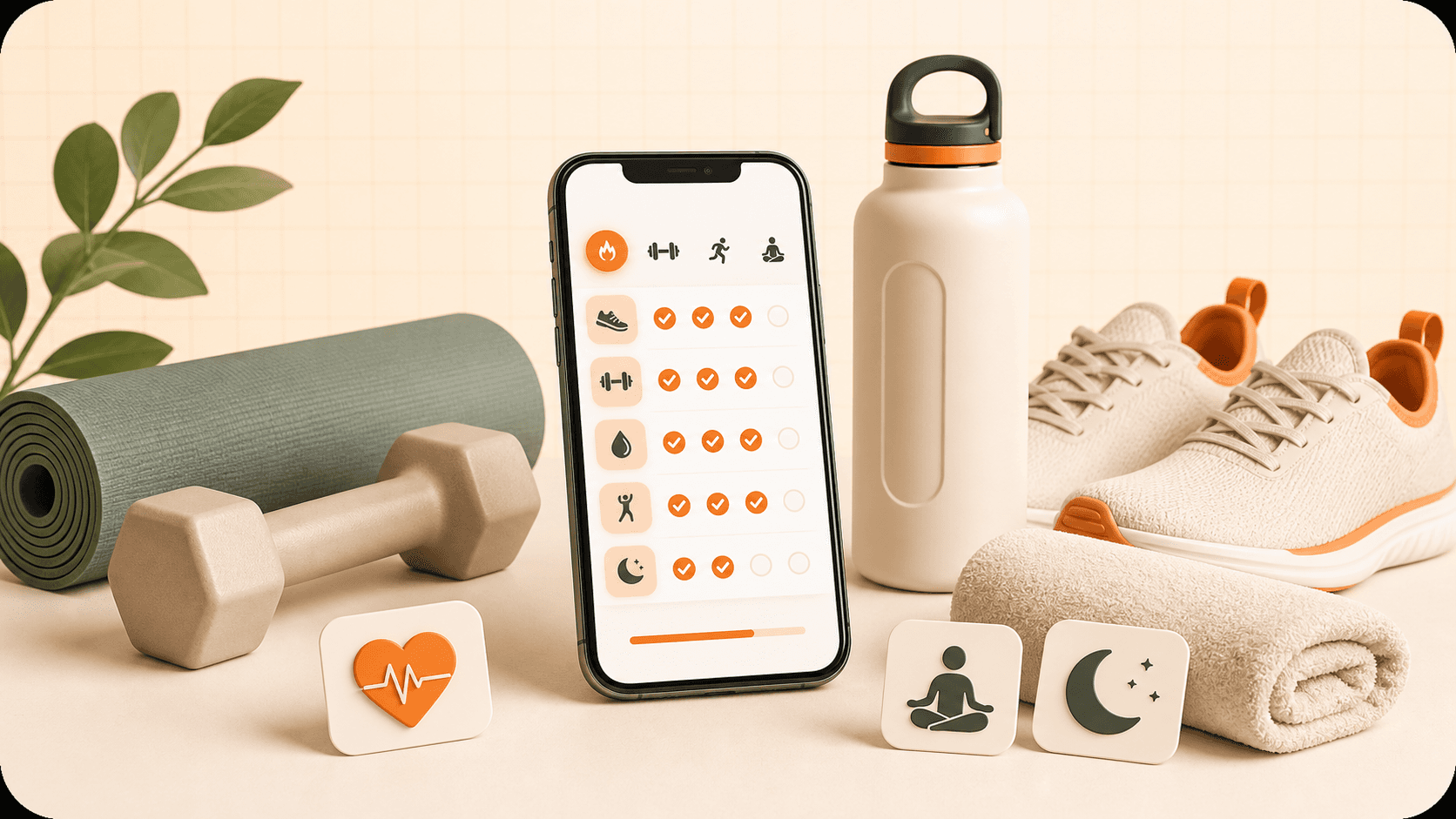
A good fitness habit tracker solves a different problem. It helps you see the behaviors that keep your body moving even when motivation dips: walking, lifting, stretching, sleeping, recovering, and returning after a missed session.
Why fitness habits fail
The usual explanation is lack of discipline. That is rarely the full story.
Fitness habits usually fail because the starting point is too intense. Someone goes from no routine to a five-day workout split, strict meal plan, daily steps goal, and perfect bedtime all at once. For a few days, the novelty carries them. Then life pushes back.
The second reason is poor feedback. If your only measure is weight, mirror changes, or personal records, progress can feel invisible for weeks. That makes quitting easier. A habit tracker gives you a faster feedback loop: did you show up today?
The third reason is all-or-nothing thinking. Missing one workout becomes missing the week. Missing the week becomes waiting for Monday. Waiting for Monday becomes starting over every month.
Fitness does not need that much drama. It needs repeatable signals.
What to track for fitness
Do not start by tracking everything. Track the few behaviors that make consistency more likely.
Useful fitness habits include:
Workout completed
10-minute walk
Stretch or mobility session
Protein with breakfast
Water bottle finished
Bedtime routine started
Recovery day respected
Steps goal reached
Strength session logged
Gym bag packed
Notice that not every habit is a hard workout. That matters. A sustainable fitness routine includes the actions that make training possible, not just the training itself.
Track minimums, not fantasies
The best fitness habit is small enough to complete on a difficult day.
Instead of tracking "go to the gym for one hour," try:
Do one set
Walk for 10 minutes
Put on workout clothes
Complete the warmup
Stretch for five minutes
These minimums may look too easy. That is the point. The minimum version keeps the identity alive. You are still someone who moves today, even if today is not impressive.
On high-energy days, you can do more. But the tracker should reward the behavior that keeps the chain from disappearing completely.
Build a weekly fitness tracker
Fitness does not need the same habit every day. Strength training, cardio, walking, mobility, and recovery all have different rhythms.
A simple weekly setup might look like this:
Strength training: 3 times per week
Walk: 5 times per week
Mobility: 3 times per week
Sleep routine: 5 times per week
Recovery day: 1 time per week
This is more realistic than forcing every habit into a daily checkbox. A recovery day is not a failure. It is part of the system.
If your tracker supports flexible scheduling, use it. If it does not, keep the habits broad enough that you can still mark useful movement without bending your life around the app.
The best fitness habit tracker setup for beginners
If you are starting from zero, use this five-habit setup for two weeks:
Walk for 10 minutes
Do one strength movement
Stretch for five minutes
Drink water in the morning
Pack or prepare workout clothes
This may feel underwhelming, but it builds the foundation. You are not trying to prove how hard you can go. You are teaching your brain that fitness belongs in normal life.
After two weeks, add difficulty slowly. Make the walk longer. Add another set. Move from one strength movement to a short workout. Keep the tracker focused on consistency, not punishment.
How to track workouts without obsessing
There is a difference between useful tracking and anxious tracking.
Useful tracking answers simple questions:
Did I move today?
Did I train this week?
Am I recovering enough to continue?
Which habit is breaking first?
Anxious tracking turns every number into a judgment. If your tracker makes you feel worse after a missed day, simplify it.
For most people, a habit tracker should not replace a workout log. Use the habit tracker for consistency and a separate workout note if you need sets, reps, or weights. The habit tracker answers whether the routine is alive.
Track recovery as a real habit
Recovery is often treated as the absence of training. That is a mistake.
If you want a fitness routine that lasts, track recovery behaviors directly:
Sleep on time
Light walk
Mobility work
Rest day taken
No late caffeine
Protein at meals
This helps prevent the classic cycle: train too hard, burn out, stop completely, restart aggressively, repeat.
A recovery checkbox reminds you that rest is not laziness. It is how the next workout becomes possible.
What to do when you miss a workout
Missing one workout does not break your fitness routine. The response matters more than the miss.
Use a simple recovery rule:
If you miss a planned workout, do the smallest possible movement the next day.
That might be a walk, one set of squats, or five minutes of stretching. The goal is not to compensate. The goal is to return quickly.
A fitness habit tracker is especially useful here because it shows the pattern. One missed day is normal. Three missed days may mean the habit is too big, badly timed, or attached to the wrong cue.
Fitness habits for busy people
If your schedule is unpredictable, stop building a routine that depends on perfect timing.
Track flexible habits like:
Movement before lunch
Walk after dinner
Strength work at home
Mobility before bed
Gym bag packed
These are easier to protect than rigid goals like "gym at 6 AM every weekday." Time-based habits work well for some people, but routine-based cues often survive chaos better.
After coffee. After work. After brushing teeth. After dinner. These anchors are easier to find again when the day shifts.
Paper, spreadsheet, or app?
A paper fitness tracker can work well if your workouts happen at home. A spreadsheet is useful if you like data and weekly summaries. But a habit tracker app is usually better if your fitness routine happens across different places: gym, office, home, campus, or outdoors.
Kabit works well for this because the tracker can stay simple. You do not need a complicated fitness dashboard to become consistent. You need a few repeatable behaviors and a fast way to mark them done.
The fitness habit tracker rule
Track the habit that makes the next workout easier.
Packing your gym bag makes training easier. Sleeping on time makes training easier. A short walk makes returning easier. A recovery day makes consistency easier.
That is the real purpose of a habit tracker for fitness. Not to shame you into perfection, but to help you keep the routine visible long enough for it to become part of who you are.
Start small. Track honestly. Return quickly. Let consistency do the heavy lifting.

Learn more
Discover more from the latest posts.