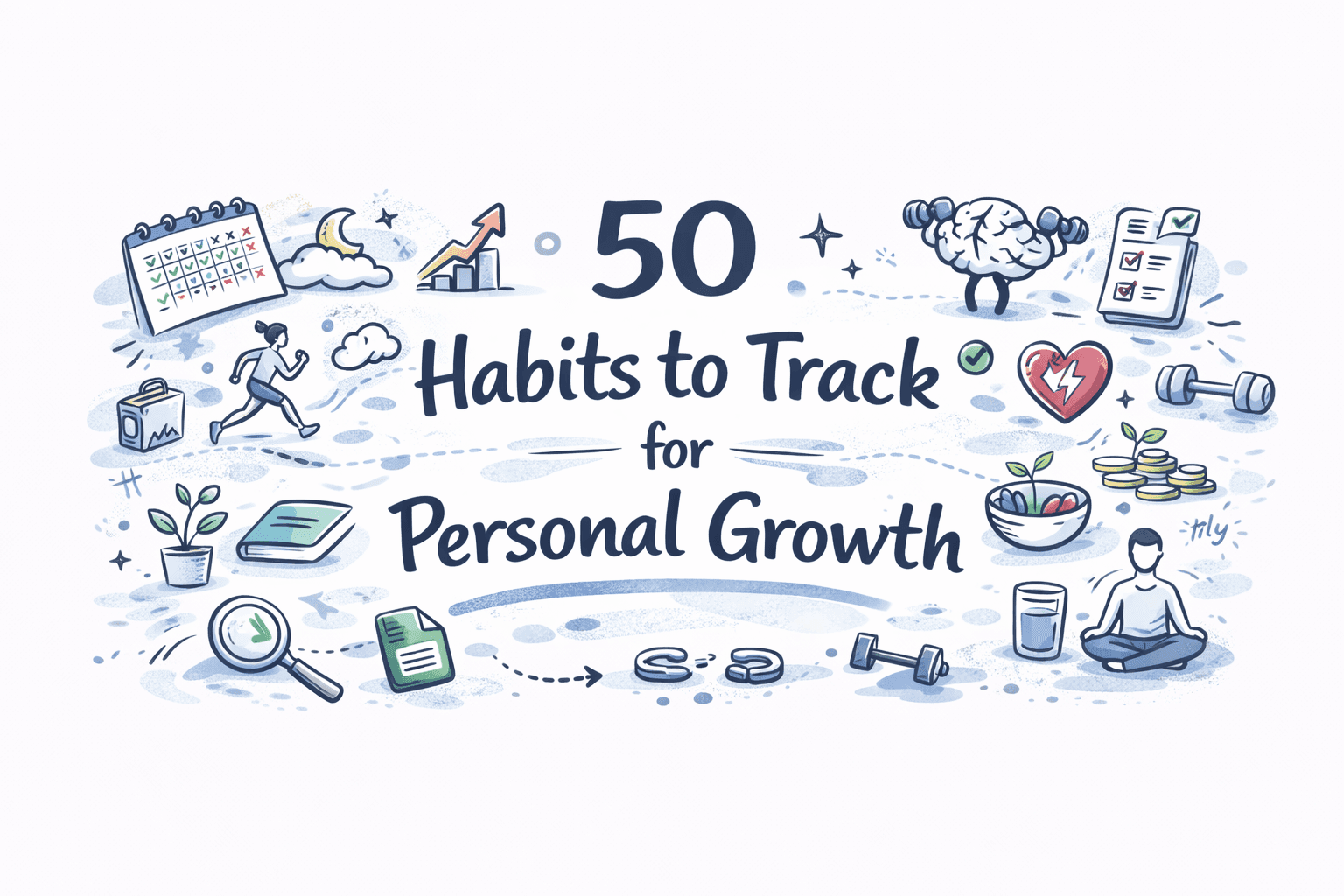
50 Habits to Track for Personal Growth (Organized by Life Area)
The most common question people ask after choosing a habit tracker isn't "how does this work?" It's "what should I actually track?"
It's a fair question. The options are overwhelming. And picking the wrong habits — ones that are too ambitious, too vague, or disconnected from what actually matters to you — is one of the main reasons people give up on tracking entirely within the first two weeks.
This list cuts through that. Fifty of the best habits to track, organized by life area, with a short note on why each one matters and how to track it effectively. Whether you're just starting out or looking to expand an existing system, there's something here for every stage.
One important note before diving in: don't try to track all 50. Start with three. Add more only once the tracking habit itself feels automatic. The goal is a system that runs on autopilot — not a system that exhausts you.
How to Use This List
Read through each category and mark the habits that genuinely resonate. Not the habits you think you should track — the ones you actually want to build. Then pick your top three across all categories and start there.
As we've covered in our guide to keystone habits, one well-chosen habit that cascades into other areas of your life is worth ten habits tracked halfheartedly. Quality of commitment beats quantity of habits every time.
Health & Fitness Habits
1. Morning walk or run Even 15–20 minutes of morning movement sets your circadian rhythm, improves mood, and creates a positive tone for the rest of the day. Track it as a simple yes/no daily check-in.
2. Drink 2 litres of water Dehydration affects cognitive function, energy, and mood long before you feel thirsty. Track by filling a marked 2L bottle each morning and finishing it by evening.
3. Exercise for 30 minutes Doesn't have to be intense — a brisk walk counts. Consistency matters more than intensity. Track completion, not performance.
4. No phone for the first 30 minutes after waking Starting your day reactively — scrolling before your brain is fully awake — sets a distracted tone that's hard to shake. This is one of the highest-leverage morning habits you can build.
5. Sleep by a consistent bedtime Consistent bedtimes regulate your circadian rhythm more effectively than total sleep hours alone. Track the behavior (in bed by X time), not the outcome (hours slept).
6. Eat a vegetable with every meal A simple, non-restrictive nutrition habit that doesn't require a diet overhaul. Easy to track, easy to build on.
7. No alcohol on weekdays A boundary-based habit rather than a quantity-based one. Binary tracking (did I keep the boundary today? yes/no) makes it clean and unambiguous.
8. 10-minute stretch or mobility work Especially valuable for desk workers. Tracks easily, takes minimal time, and the compounding benefit on posture and joint health over months is significant.
9. Take daily vitamins or supplements A simple completion habit. Leave them next to your coffee maker so the environmental cue is built in.
10. Step count goal (8,000–10,000 steps) Passive tracking at its best — most phones and watches log this automatically. Review it daily and adjust behavior accordingly.
Mental Health & Wellbeing Habits
11. Meditate for 10 minutes Research from Harvard Medical School shows consistent meditation reduces anxiety, improves focus, and lowers cortisol. Start with 5 minutes if 10 feels like too much.
12. Write three things you're grateful for Gratitude journaling rewires your brain's negativity bias over time. Takes under two minutes. Track it as part of a morning or evening routine.
13. Digital detox hour before bed Blue light and social media stimulation before sleep degrades sleep quality significantly. Track the boundary: screens off by X time.
14. Spend time in nature Even 10 minutes outside — without a screen — reduces cortisol and improves mood. Research from the University of Michigan found significant stress reduction from short nature exposure.
15. Journal (free writing) Unstructured writing for 5–10 minutes processes the day's events, surfaces patterns, and reduces mental clutter. Track completion, not quality or length.
16. No social media before noon Protecting your morning from comparison and reactive scrolling preserves the most cognitively valuable hours of your day for intentional work and habits.
17. Practice deep breathing or box breathing A 2–3 minute breathwork practice activates the parasympathetic nervous system and reduces acute stress. Easy to stack onto an existing morning or evening habit.
18. Say no to one unnecessary commitment A behavioral habit, not a physical one. Track it as a weekly habit — once a week, consciously decline something that doesn't align with your priorities.
19. Limit news consumption to once daily Constant news consumption increases anxiety without improving your ability to act on it. A single 15-minute check-in is enough to stay informed.
20. Check in with your emotional state A simple daily habit: rate your mood on a 1–5 scale each evening. Over weeks, patterns emerge that tell you exactly which habits are correlated with your best days.
Productivity & Focus Habits
21. Plan tomorrow the night before Three priorities, written down before you sleep. This habit eliminates the common morning problem of spending the first hour deciding what to work on.
22. Deep work block (90 minutes, no interruptions) Research by Cal Newport shows that single-minded focus produces higher-quality output and more career progress than fragmented multitasking. Track whether you completed one protected deep work session.
23. Check email only twice daily Reactive email habits destroy focused work time. A strict morning and afternoon check-in is sufficient for most work situations and dramatically improves focus quality.
24. Clear your inbox to zero A daily completion habit. Track it as done/not done. The consistency of the habit matters more than perfection in execution.
25. Complete your top priority task before noon Your best cognitive energy is in the morning. Protecting it for your single most important task each day compounds significantly over months.
26. No meetings before 10 AM A boundary habit that protects your peak morning hours for deep work. Track whether you maintained the boundary each day.
27. Review your weekly goals every Sunday A weekly habit that connects daily actions to longer-term goals. Takes 15 minutes and dramatically improves intentionality across the week.
28. Learn something new for 20 minutes A broad category: a language lesson, an online course, reading in a new field, a skill practice session. Track completion, not topic.
29. Single-task for at least one hour No tabs, no notifications, one task. Track the behavior as a daily yes/no — did you spend at least one uninterrupted hour on a single task today?
30. End your workday with a shutdown ritual A consistent end-of-work routine — reviewing what you completed, writing tomorrow's priorities, and physically closing your laptop — creates a clean psychological boundary between work and rest.
Reading & Learning Habits
31. Read 10 pages per day Ten pages daily equals roughly 12–15 books per year. Track by pages, not time — it's a cleaner metric.
32. Read non-fiction for 20 minutes Specifically non-fiction if your goal is learning and growth. Track time spent, not chapters completed.
33. Listen to an educational podcast episode A passive learning habit that stacks easily onto commuting, exercise, or household chores. Track it as done/not done.
34. Take notes on what you read The habit of capturing ideas from reading dramatically improves retention and application. Even three bullet points per session counts.
35. Practice a language for 15 minutes One of the highest-ROI learning habits for long-term personal growth. Apps like Duolingo make this easy to track — your streak is built in.
Financial Habits
36. Log every expense Awareness is the foundation of financial health. Tracking where money goes — even without a budget — changes spending behavior within weeks. Research from the American Psychological Association links financial awareness directly to reduced money stress.
37. No unnecessary purchases today A daily mindfulness habit around spending. Binary — did you make any impulse purchases today? Track honestly.
38. Transfer a fixed amount to savings Automating this removes the decision, but tracking it keeps it conscious and intentional. Even small daily savings tracked consistently build significant long-term momentum.
39. Review your financial dashboard weekly A weekly habit: open your banking or budgeting app, review income versus spending, and check progress toward savings goals. Takes 10 minutes and eliminates financial anxiety by replacing avoidance with awareness.
40. Read or listen to one piece of financial content weekly A learning habit specifically for financial literacy. One article, one podcast episode, one book chapter per week compounds into significant financial knowledge over a year.
Relationships & Social Habits
41. Message one friend or family member A deliberate connection habit. Not a group chat scroll — a direct, personal message to someone you care about. Takes two minutes and compounds into significantly stronger relationships over months.
42. Put your phone away during meals A presence habit. Track it as a daily yes/no — were you phone-free during at least one meal today?
43. Express appreciation to someone A verbal or written expression of genuine appreciation — to a colleague, partner, friend, or family member. Track once daily.
44. Have one meaningful conversation Not small talk — a conversation with real depth, curiosity, or vulnerability. Track as a weekly habit rather than daily.
45. Spend one hour of quality time with family Screen-free, present, engaged time with the people who matter most. Track completion as a daily or weekly habit depending on your situation.
Personal Development Habits
46. Review your personal goals monthly A monthly habit: read through your longer-term goals, assess progress honestly, and adjust actions for the coming month. Connects daily habits to the bigger picture.
47. Do something uncomfortable daily Deliberately choosing one small thing that creates discomfort — a difficult conversation, a cold shower, a challenging workout, asking for feedback. Tracks as a yes/no.
48. Reflect on one win from today A confidence-building habit. Before bed, identify one thing that went well — however small. Builds self-efficacy over time without requiring external validation.
49. Spend time on a creative pursuit Writing, drawing, building, designing, playing music — anything that engages you creatively for its own sake. Even 15 minutes daily sustains creative capacity that purely consumption-based habits erode.
50. Practice your keystone habit without exception Whatever your single most important habit is — the one that, when you do it, makes everything else easier — track it every day without negotiation. This is the non-negotiable. Everything else can flex.
How to Pick Your Starting Three
With 50 options, the selection can feel overwhelming. Here's a simple framework: pick one habit from health, one from productivity, and one from mental wellbeing. These three categories have the strongest cross-category spillover effects — improvement in one tends to lift the others.
Then track them using whatever system you'll actually use every day. If that's a free printable habit tracker stuck to your fridge, great. If it's a Notion database, great. If you want the fastest, most frictionless daily check-in available, a dedicated daily habit tracker app removes every barrier between you and your streak.
The habits on this list aren't magic. What's magic is the consistency you build by showing up for them every single day — tracked, visible, and impossible to ignore.
Start with three. Build from there. Visit kabitapp.com for the science-backed guides that help every habit on this list actually stick.

Learn more
Discover more from the latest posts.