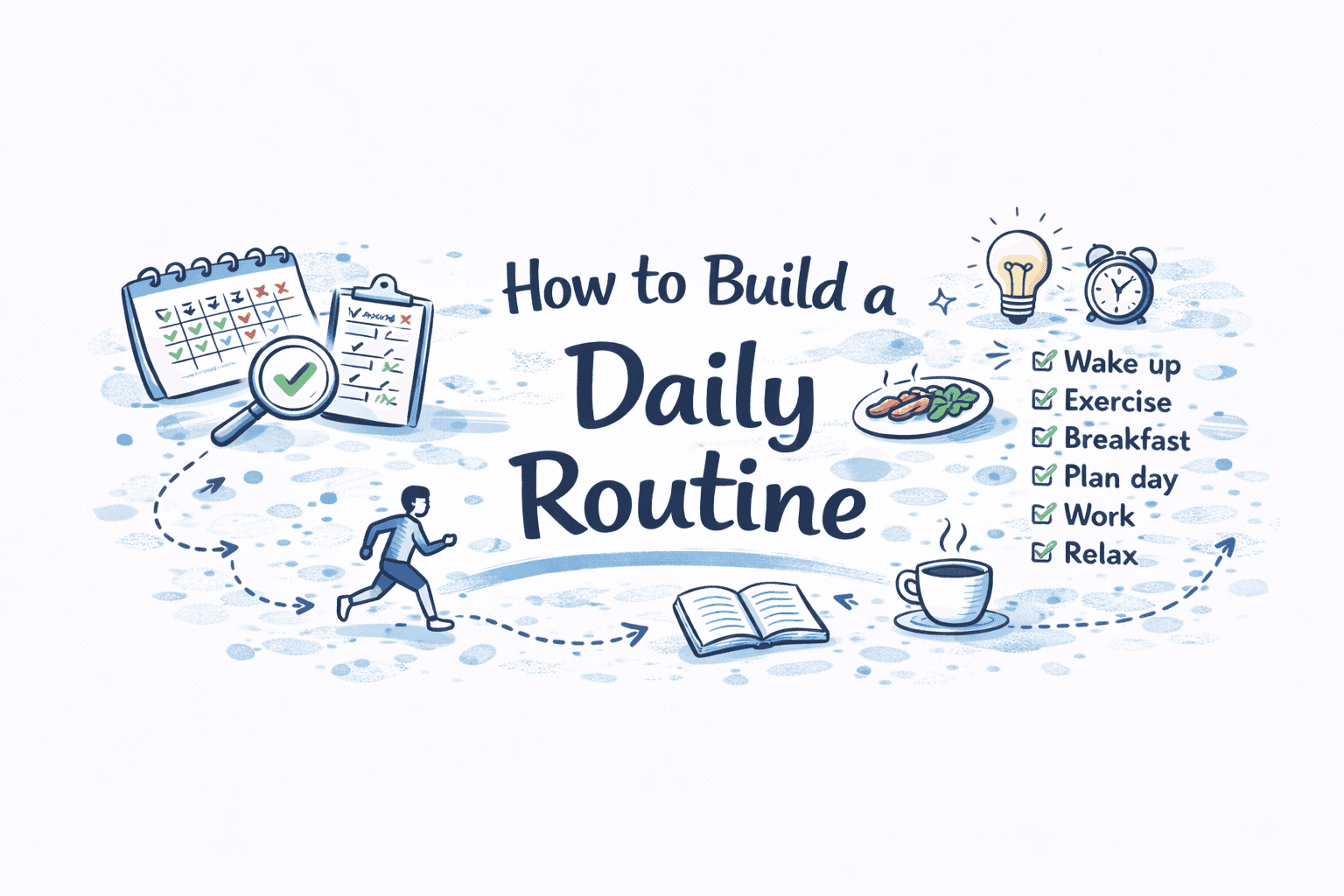
5 Simple Steps to Build a Daily Routine That Actually Sticks
I've designed and abandoned more morning routines than I can count.
5 AM wake-ups. Cold showers. Journaling, meditation, exercise, reading — all before 8 AM. Each attempt lasted about ten days before the whole thing collapsed under the weight of its own ambition.
What I eventually figured out — and what the research confirms — is that the problem was never discipline. It was design. Most daily routines fail because they're built backwards: aspirational first, sustainable never.
This guide is the opposite of that. Five steps, grounded in actual habit science, for building a daily routine that still exists six months from now.
Why Most Daily Routines Fail Within Two Weeks
Research consistently demonstrates that "too much change, too fast" is likely to end without positive results. Education Week This is the core failure mode of almost every daily routine attempt: people design the routine they want to have rather than the routine they can actually sustain. The gap between those two things is where consistency goes to die.
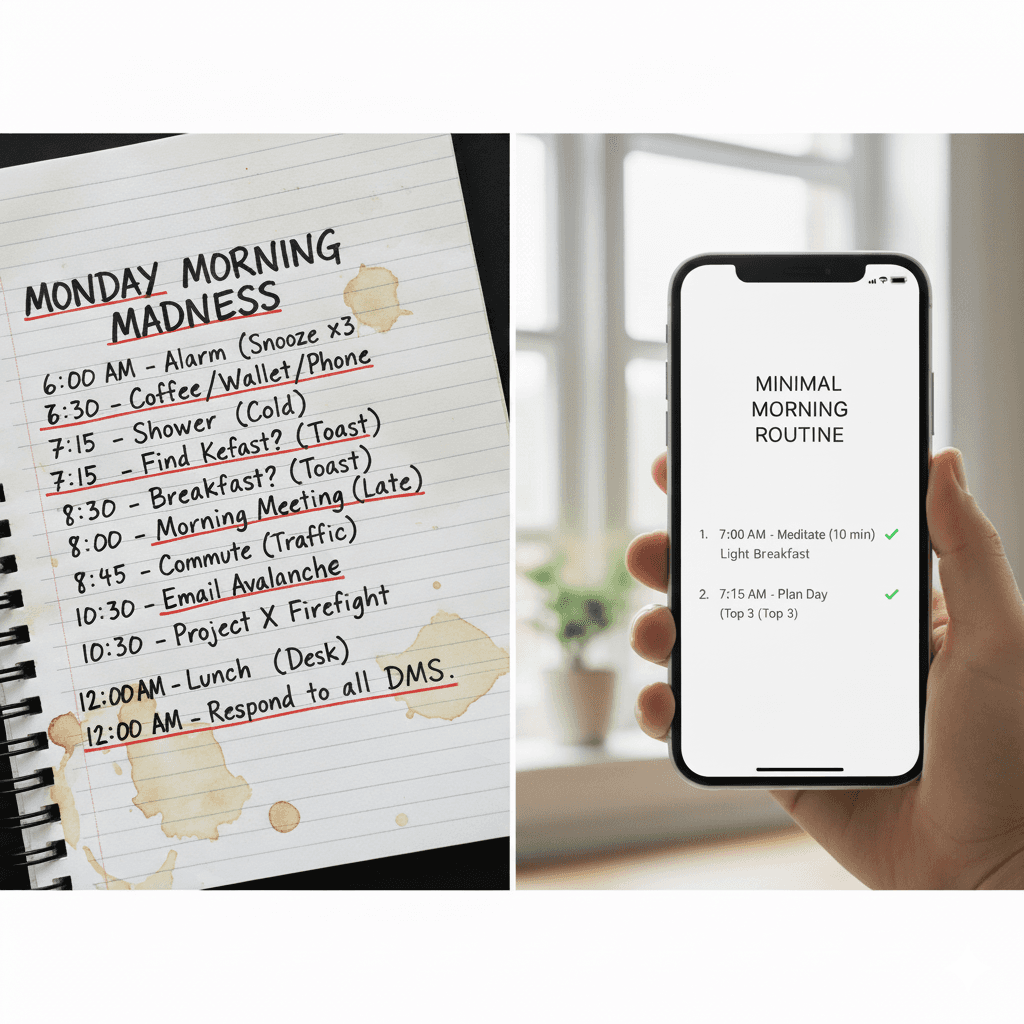
The second failure mode is a structure without flexibility. Most routines are built around a rigid time schedule — 6 AM this, 6:30 AM that — which makes a single disruption feel like total collapse. One late night, one early meeting, one sick day, and the whole system breaks.
The third failure mode is optimising for the best day rather than the worst day. A daily routine only works if it works on Tuesday when you're exhausted, not just on Sunday when you're inspired.
The five steps below address all three failure modes directly.
Step 1 — Identify Your "Anchor Habits" First
Before you decide what your routine will contain, you need to map what it already contains.
Every day, you already do a handful of things automatically — wake up, make coffee, brush your teeth, sit down at your desk, eat lunch. These are your anchor behaviors: actions so deeply ingrained they happen without conscious decision.
A cue located within an existing daily routine provides a convenient and stable starting point for new habits — because the context is already salient in daily life and encountered consistently. PubMed Central This is the foundational insight of routine design: you don't build a new routine from scratch. You build onto the architecture that already exists.
Write down your three most consistent daily anchors — the things you do at roughly the same time in the same context every single day. These become the skeleton of your routine. Everything new you add will attach to one of them.
For me, those three anchors are: making coffee in the morning, sitting down at my desk, and brushing my teeth before bed. Every habit I've successfully built in the last two years lives on one of those three pegs.
Step 2 — Choose Two New Behaviors (Not Six)
This is where most people resist the advice — and where most people fail.
Studies have shown that up to 40–45% of our daily actions are already habitual. PubMed Central Which means your day is already mostly routine, whether you've designed it consciously or not. Adding new behaviors means competing with existing neural patterns for bandwidth — and that competition is harder than it looks.
Adding in too many changes at once will likely be difficult to sustain and may result in behavior relapse. Education Week Health researchers recommend adding one to two changes at a time, slowly building a routine that actually holds.
Two new behaviors. That's the limit for the first month.
Choose them based on three criteria: they're specific enough to be binary (done or not done), small enough to complete on your worst day, and genuinely connected to something you care about. "Exercise" fails all three tests. "Do ten push-ups after my morning coffee" passes all three.
Research shows that self-selected habits — ones you've chosen yourself — have a 37% higher success rate than externally imposed ones. ADDA Choose what matters to you, not what a productivity influencer told you successful people do at 5 AM.

Step 3 — Stack Each New Behavior onto an Anchor
Now connect your two new behaviors to the anchors you identified in Step 1.
The formula is simple: "After I [anchor behavior], I will [new behavior]."
After I make my morning coffee → I will write three sentences in my journal. After I sit down at my desk → I will review my top three priorities for the day. After I brush my teeth at night → I will do five minutes of stretching.
This is habit stacking — and it works because you're borrowing the cue reliability of a behavior that already fires automatically. You don't have to remember to do the new habit. The anchor behavior triggers it.
Research has shown that participants who utilized trigger events to initiate behaviors reported higher levels of automaticity compared to those who relied solely on reminders. American Psychiatric Association A contextual trigger — something you do — is significantly more reliable than a time-based reminder or willpower alone.
One rule: keep the new behavior immediately adjacent to the anchor. Don't stack "go for a 30-minute run" onto "drink morning coffee" if there's a shower, commute, and work call between them. Proximity matters. The shorter the gap between anchor and new behavior, the stronger the association your brain builds.
Step 4 — Design for Your Worst Day, Not Your Best
This step is the one that separates routines that last from routines that look great in a screenshot.
Ask yourself: what is the minimum viable version of each behavior? The version you can complete when you're sick, running late, or running on four hours of sleep?
For journaling: three sentences, not three pages. For exercise: ten push-ups, not a full gym session. For reading: one page, not thirty minutes.
When people cannot meet their own expectations or if the activity is too hard, they can be deterred from trying again — instead, try scaling back significantly and then gradually working back up to the original goal. ADHD Evidence
The minimum viable version is not your goal. It's your floor. On good days you'll do more. But the floor is what keeps the streak alive on the hard days — and keeping the streak alive on the hard days is what builds the routine.
Morning routines tend to stick better than evening ones, possibly because there are fewer distractions and more mental energy early in the day. arXiv If you have a choice about when to place a new behavior, morning anchors are generally more reliable than evening ones — though the best time is always whichever time you'll actually show upStep 5 — Track It and Review Weekly
A routine becomes self-sustaining when you have evidence that it's working. Without tracking, you're running on feel — and feel is unreliable, especially during the plateau phase when the routine still requires effort but the novelty has worn off.
A simple daily tick-sheet for self-monitoring performance can help during the learning phase — tracking allows you to watch automaticity develop over time. PubMed Central You don't need anything complex. A daily check after each behavior — done or not done — gives you the feedback loop that keeps the routine alive during weeks three to six, when motivation has dipped but automaticity hasn't arrived yet.
The weekly review matters just as much as the daily tracking. Every Sunday, ask three questions:
Which behaviors did I complete most consistently? These are working — protect them. Which did I skip most often? These need adjustment — smaller, better anchor, different time. What disrupted the routine most? Address that specific friction point, not the whole system.
Consistent repetition over time was ultimately what mattered most — and skipping a day occasionally didn't derail the habit-forming process. ADDA The review isn't about punishing misses. It's about learning from the pattern so the next week is better designed than the last.
For tracking, the simplest system is a dedicated daily habit tracker app — something that lives on your phone, fires a reminder at the right moment, and shows your streak over time. The visual evidence of consistency is more motivating than any amount of planning.
What to Expect in the First 90 Days
Most people expect a routine to feel automatic within three weeks. The research says otherwise.
Forming lasting habits typically requires two to five months of consistent practice, with some people needing nearly a year to make behaviors truly automatic. arXiv The plateau — where the routine still requires conscious effort but no longer feels novel — hits somewhere between days 14 and 45. This is the highest-risk dropout point.
Knowing it's coming makes it survivable. When week three feels harder than week one, that's not failure — that's the formation process working exactly as it should. Keep the floor behaviors in place, keep the daily tracking going, and the automaticity will arrive.
For a deeper look at what's actually happening neurologically during this process — and how long your specific habits are likely to take — how long it really takes to build a habit covers the science in full.
When you're ready to start, kabitapp.com is built around exactly these principles: minimal friction at check-in, anchor-based reminders, and streak tracking that makes the long formation process feel visible and manageable.
🎯 Key Takeaways
Most daily routines fail for three reasons: too many changes at once, rigid time-based structure, and designed for the best day rather than the worst — all fixable with the right setup
The five-step system: map your existing anchors → choose two new behaviors → stack onto anchors → define your minimum viable version → track and review weekly
Expect the routine to require conscious effort for 6–10 weeks — the plateau between days 14 and 45 is normal, not failure, and daily tracking is what makes it survivable

Learn more
Discover more from the latest posts.