How Long Does It Really Take to Build a Habit? (The Science, Not the Myth)
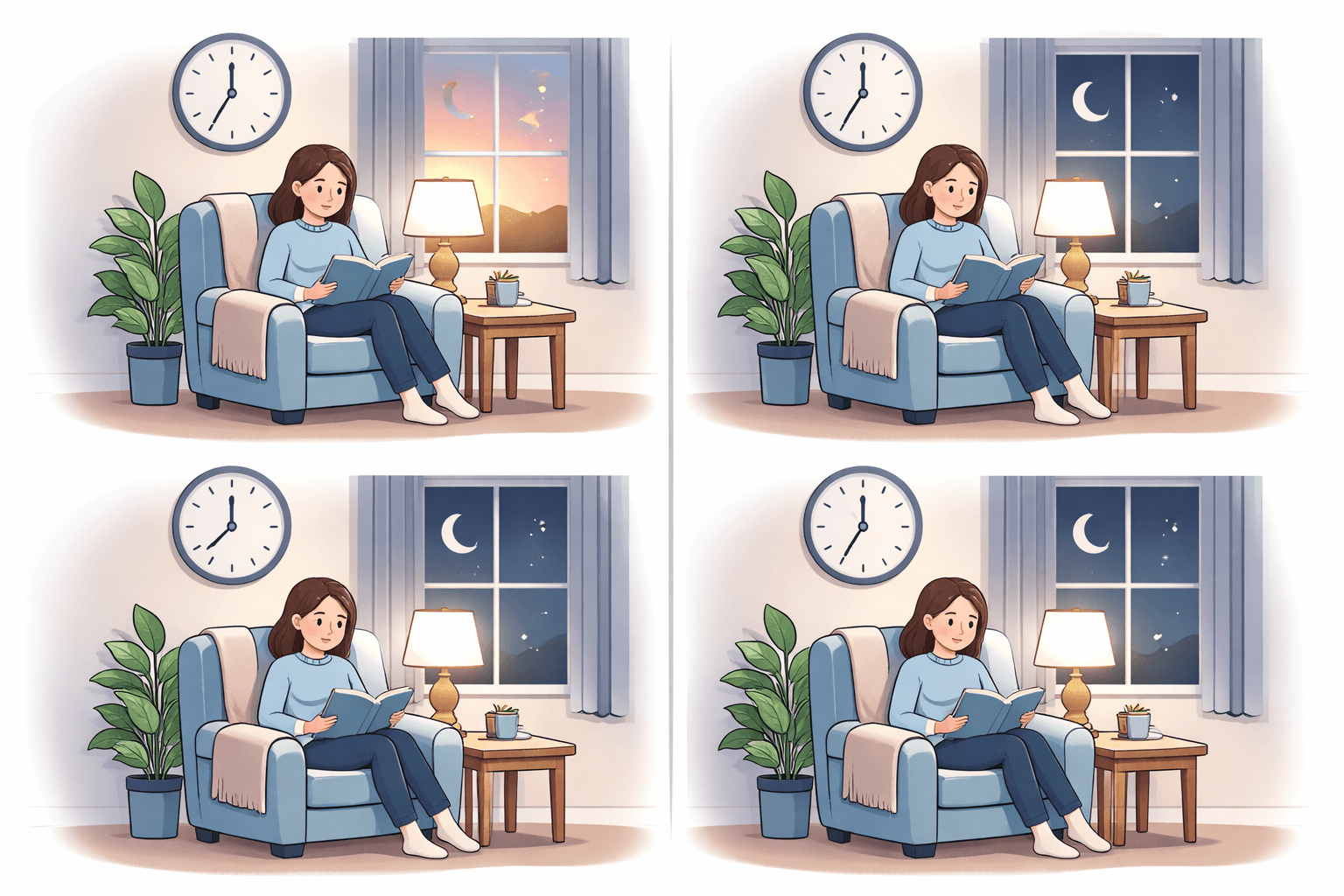
Here's something I noticed after tracking habits obsessively for two years: my evening reading habit became automatic in about 40 days. My morning exercise habit took closer to 110. Same person, same tracking system, same level of commitment — wildly different timelines.
That gap used to frustrate me. Now I understand exactly why it happened — and it changed how I set up every new habit I build.
The "21 days to form a habit" rule is not just wrong. It's wrong in a way that causes real damage — because it sets a deadline that most habits will miss, turning a normal part of the formation process into apparent failure. People quit at day 25 not because the habit isn't working, but because they were told it should feel automatic by now.
The honest answer to how long it takes is this: it depends. But the factors it depends on are specific, knowable, and — crucially — within your control.
Where the 21-Day Myth Came From (And Why It Spread So Fast)
In 1960, a plastic surgeon named Maxwell Maltz published a book called Psycho-Cybernetics. He'd noticed that patients adjusting to cosmetic surgery — a new nose, a reconstructed jaw — typically took about three weeks before the change felt normal.
His observation: "It usually requires a minimum of about 21 days for an old mental image to dissolve and a new one to jell."
Two words did all the damage: minimum and image. Maltz was talking about psychological adjustment to physical appearance, not behavioral habit formation. And he explicitly said minimum. But by the time the self-help industry was done with it, "a minimum of 21 days" had become "exactly 21 days" had become "the scientific rule for any habit."
It spread because it's optimistic and finite. Three weeks feels achievable. It doesn't spread because it's true.
What the Research Actually Says
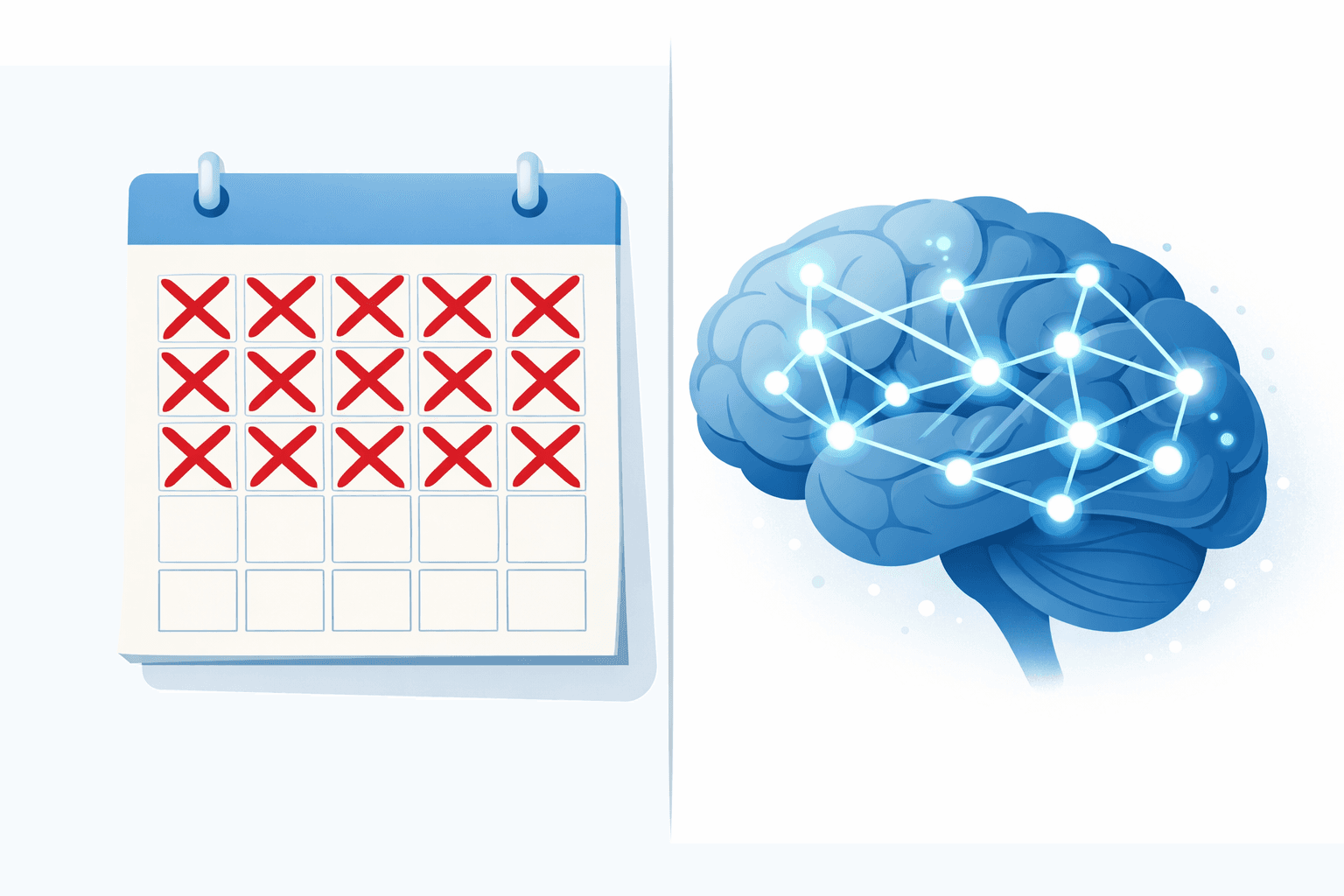
In 2010, Dr. Phillippa Lally and her team at University College London published the study that finally put real numbers on habit formation. They followed 96 people over 12 weeks as each tried to adopt a new daily behavior — drinking water with lunch, eating a piece of fruit, going for a run before dinner.
The finding that made headlines: it took an average of 66 days for a behavior to become automatic.
The finding that most articles leave out: the range was 18 to 254 days.
That range is the real story. One person automated their behavior in under three weeks. Another took nearly nine months. Both were doing the same kind of thing — a simple daily behavior, consistently repeated. The difference was in the factors that determine each individual's personal timeline.
A more recent 2024 systematic review published in Healthcare journal, analyzing over 2,600 participants across 20 studies, confirmed the timeline: 59 to 335 days for most everyday habits, with a median around 66 days.
The bottom line: if you're on day 30 and your habit still feels effortful, you're not behind. You're completely on schedule.
The 4 Factors That Determine Your Personal Timeline
This is the part no one talks about — and it's the most useful. Your habit formation timeline isn't random. It's driven by four specific variables, each of which you can assess and adjust.
Factor 1 — Behavioral complexity
The single strongest predictor of formation time is how many decisions and physical steps the behavior requires.
Simple behavior: "Drink a glass of water after waking up." One step. One decision. No equipment. Forms in 3–4 weeks for most people.
Complex behavior: "Go to the gym for 45 minutes." Multiple steps — get changed, travel, workout, return, shower. Multiple decision points. Can take 3–6 months before it feels truly automatic.
This is why I always tell people building their first habit to choose something embarrassingly simple. Not because simple habits are the end goal — but because a simple habit that becomes automatic in 5 weeks gives you a working system and genuine identity evidence before you layer in complexity.
Factor 2 — Context stability
Habits form faster when the behavior always happens in the same context — same time, same place, same preceding activity. Context is the cue your brain uses to fire the behavioral chunk automatically.
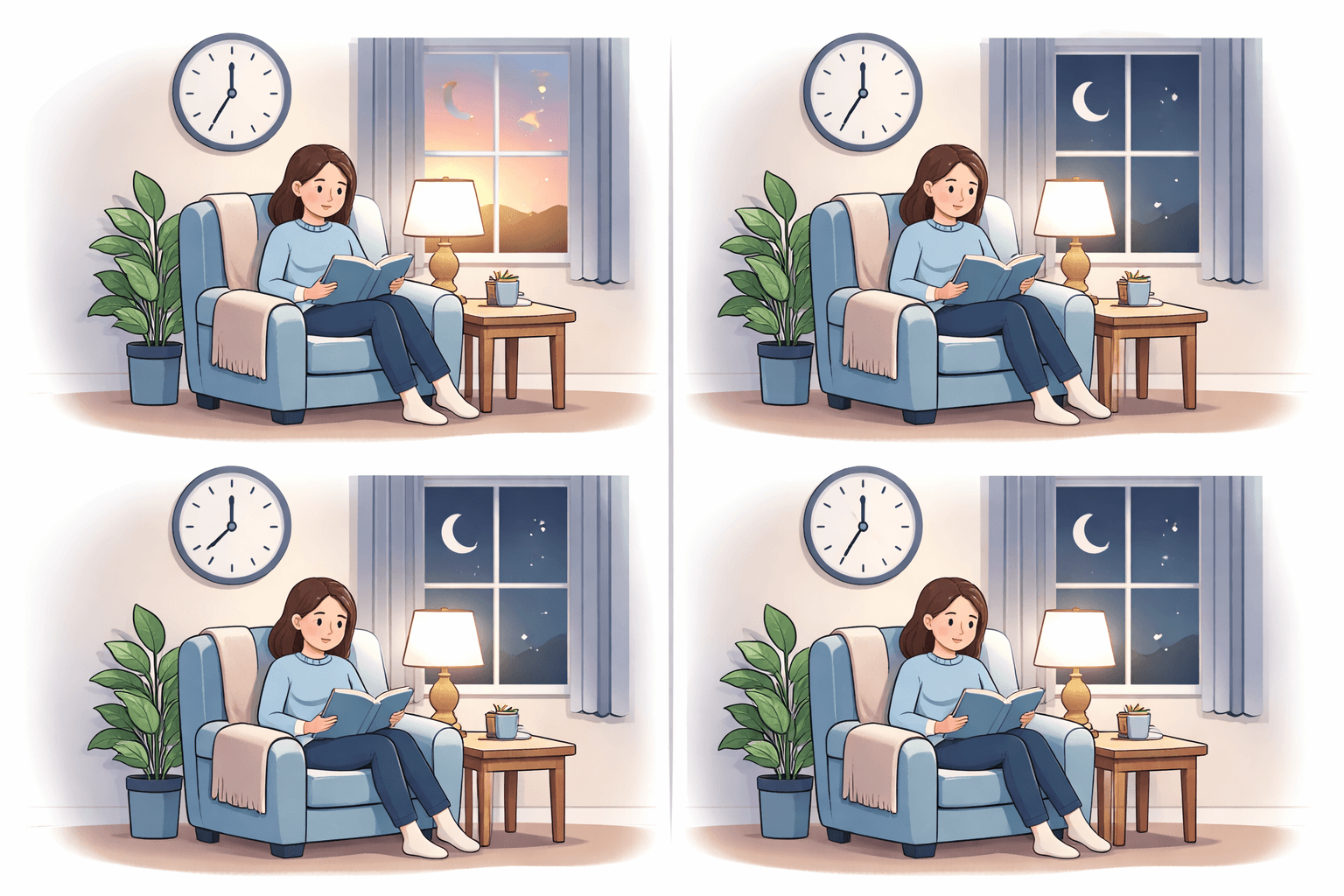
My reading habit automated in 40 days because it happened in the same chair, at the same time (9 PM), after the same preceding behavior (finishing dinner). My brain had a reliable, stable cue to associate the behavior with.
My exercise habit took 110 days because the time varied — sometimes morning, sometimes lunchtime, sometimes evening depending on my schedule. Inconsistent context = slower neural encoding. Research on context-dependent habit formation from USC's Wendy Wood confirms this directly: stable context is one of the strongest accelerators of habit automaticity.
Fix: If your habit is taking longer than expected, ask first whether it's happening in a stable context. If the time or location varies week to week, that's likely your bottleneck — not your commitment.
Factor 3 — Intrinsic enjoyment
Habits you genuinely enjoy form faster than habits you endure. This sounds obvious, but its practical implications are underappreciated.
Lally's original research found that behaviors with intrinsic reward — where the activity itself produced pleasure or satisfaction — became automatic after significantly fewer repetitions than behaviors that felt like obligations.
This means that choosing a form of exercise you actually enjoy will build faster than the "optimal" workout you dread. The meditation app you find genuinely calming will automate faster than the one that feels like homework. Enjoyment is not a luxury in habit formation — it's an efficiency factor.
Factor 4 — Frequency of repetition
More repetitions in a shorter timeframe = faster automaticity. A habit practiced daily forms faster than one practiced three times a week, even if the total number of repetitions over months is the same. Daily repetition keeps the neural pathway active and prevents the association from fading between sessions.
This is one of the most practical insights from the research: if a habit is taking too long to feel automatic, increase its frequency before increasing its intensity. More often, smaller, builds faster than less often, bigger.
The "Automaticity Curve" — What Habit Formation Actually Feels Like
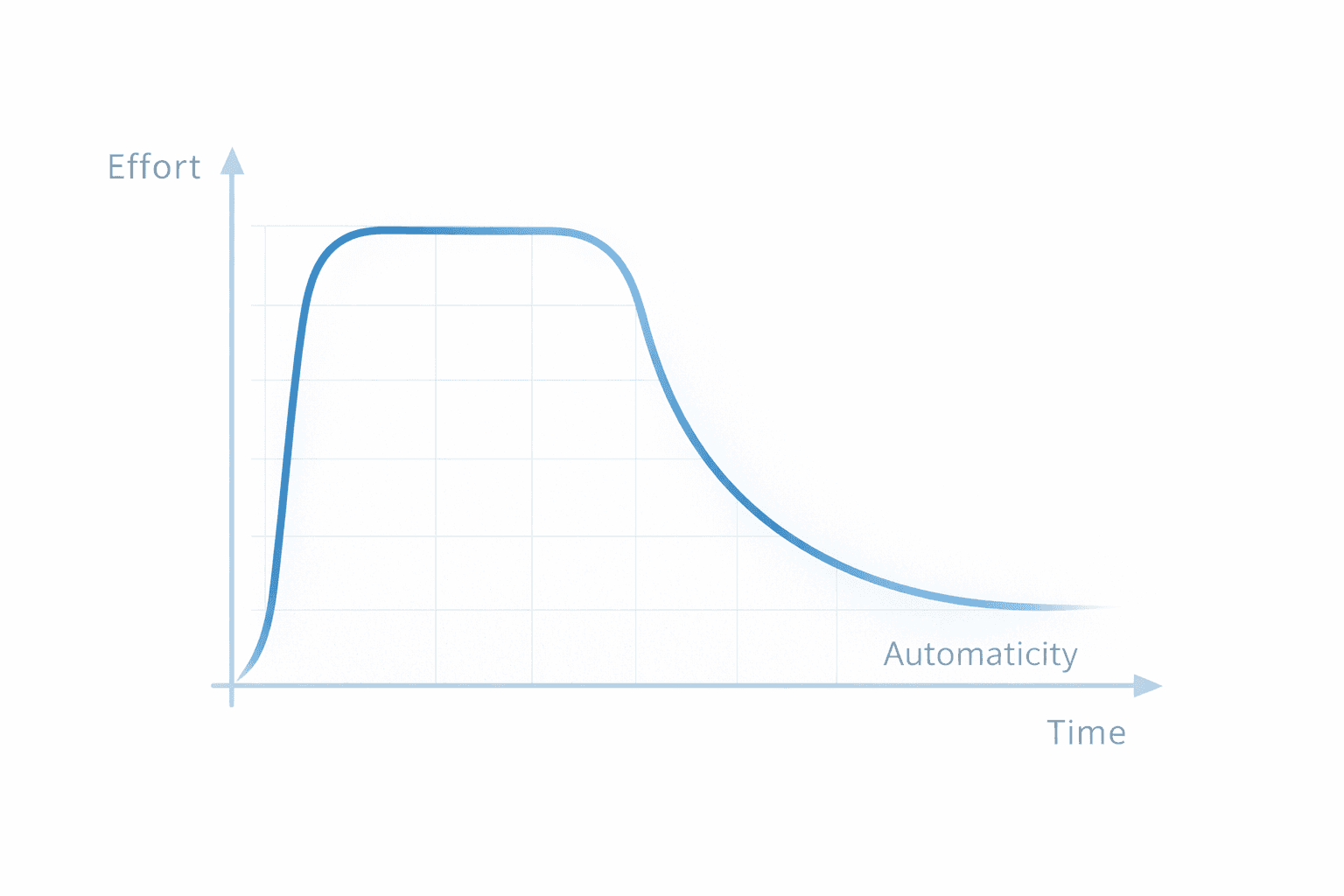
Understanding the shape of the formation process is as important as knowing the timeline. Habit formation doesn't progress linearly. It follows a curve.
Weeks 1–2 (High effort, high motivation): The behavior requires conscious effort every single time. Motivation is still elevated from the initial decision to start. This phase feels harder than it will — but also more supported.
Weeks 3–6 (The plateau — highest dropout risk): Motivation has declined but automaticity hasn't arrived. The behavior still requires effort, but the novelty that was sustaining you has worn off. This is where the 21-day myth causes the most damage — people hit week three, feel no automation, conclude the habit isn't working, and quit.
Weeks 6–12+ (Automaticity building): The behavior starts to feel lighter. You begin doing it without the internal debate that characterized weeks three to six. The cue starts reliably triggering the routine.
Beyond 12 weeks (Full automaticity): For complex habits, this is when the behavior finally feels truly self-sustaining. You notice its absence on the days you miss it. The identity has shifted.
Knowing which phase you're in changes everything. The plateau phase — weeks three to six — isn't evidence of failure. It's the most neurologically significant period of the entire formation process. Quitting in the plateau is like leaving a cake in the oven for 25 of the 30 minutes it needs and calling it burned.
What I Learned Tracking My Own Habits in Kabit
When I started using Kabit seriously, I ran a personal experiment: I tracked five habits simultaneously and logged not just completion but difficulty — how much conscious effort each day required on a 1–5 scale.
What the data showed surprised me.
My water intake habit (simple, same context every morning) hit low-effort scores by day 28. My journaling habit (moderate complexity, consistent evening timing) hit low-effort by day 52. My strength training habit (high complexity, variable timing) was still scoring 3–4 effort at day 90 and didn't consistently hit low-effort until day 115.
The formation timeline matched almost exactly what the research predicts based on complexity and context stability. But seeing it in my own data — watching the effort score slowly trend downward over weeks — made the plateau phase feel manageable rather than alarming. I could see progress even when the habit didn't feel automatic yet.
That's the practical value of tracking that most people miss. It's not just accountability. It's evidence that the process is working during the phase when it feels like it isn't.
How to Use This to Set Up Your Next Habit Correctly
Now that you know what drives your personal timeline, here's how to use it:
Before you start: Rate your habit on complexity (1–5) and ask whether you can commit to a stable time and place every day. High complexity + unstable context = expect 3–6 months. Low complexity + stable context = expect 4–8 weeks. Set your expectations accordingly before day one.
During weeks 3–6 (the plateau): Do not interpret difficulty as failure. Reduce the habit to its minimum viable version if needed — but keep showing up. This is the phase the neural pathway is actually being built, even if it doesn't feel that way.
If formation is taking longer than expected: Check context stability first. Then check frequency. Then check whether you actually enjoy the behavior or are just tolerating it. One of these three is almost always the bottleneck.
Track your effort, not just your completion. Completion tells you whether you showed up. Effort tells you where you are on the automaticity curve. Both matter. A daily habit tracking app that shows your streak over time gives you the visual evidence you need to stay patient during the plateau.
The Question That Changes Everything
Most people ask: "How long will this take?"
The better question is: "What would make this take less time?"
Simpler behaviour. More stable context. Higher enjoyment. Daily frequency. Those four levers are entirely within your control — and adjusting any one of them measurably shortens your formation timeline.
The 21-day rule gave you a deadline. The real science gives you a process. The process is more useful — because it tells you not just how long to expect, but exactly what to do to get there faster.
For a complete framework on building habits that stick across every timeline, kabitapp.com has everything you need — and the definitive guide to habit tracking is the best place to start.
🎯 Key Takeaways
The average habit takes 66 days to form — with a real-world range of 18 to 335 days depending on the person and behavior
The four factors that control your personal timeline: complexity, context stability, enjoyment, and frequency — all adjustable
Weeks 3–6 are the highest-risk dropout phase, not because the habit isn't working, but because the 21-day myth sets a false deadline right in the middle of the most critical formation period

Learn more
Discover more from the latest posts.