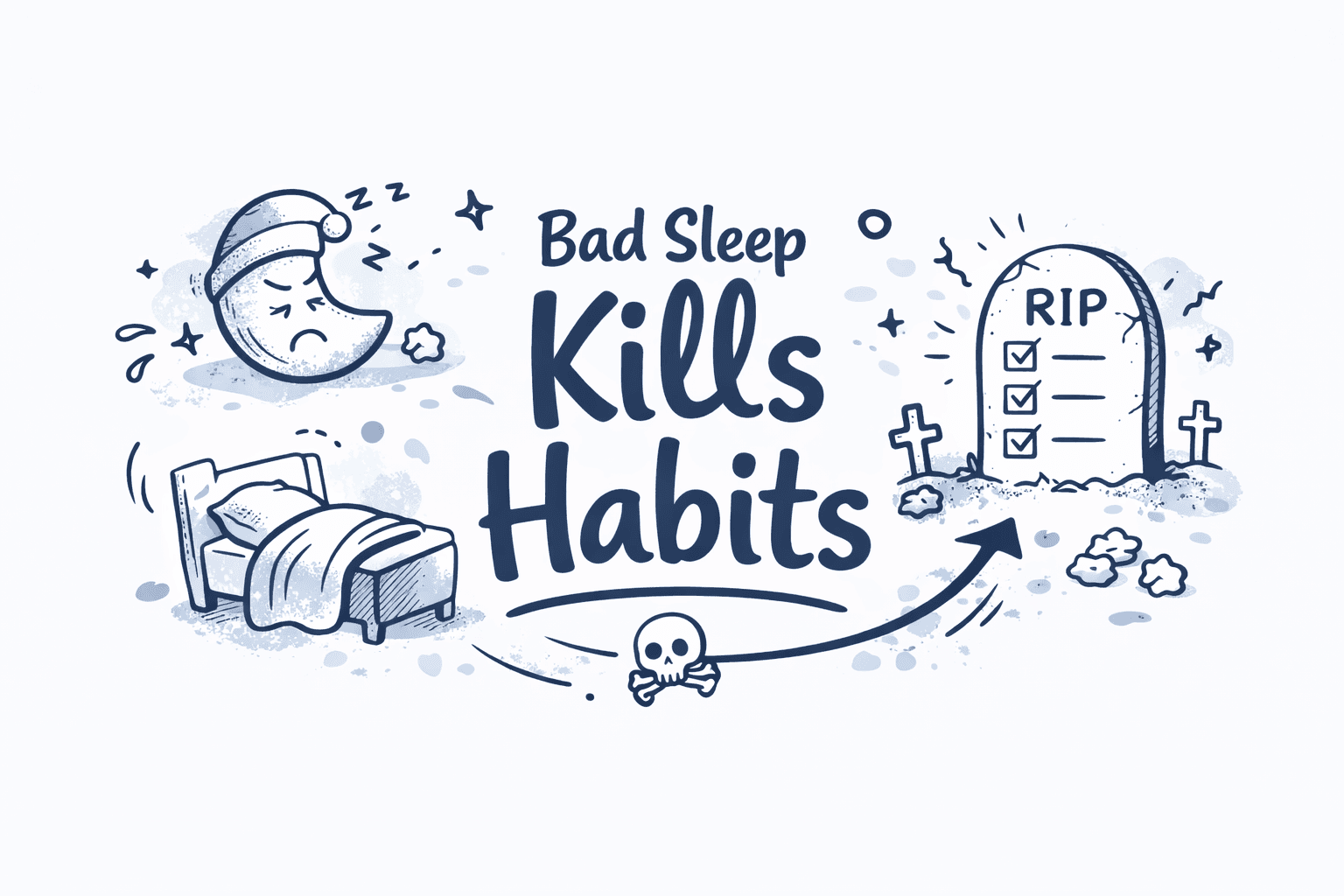
Why Bad Sleep Is Quietly Destroying Your Habits (And What to Do About It)
I used to blame my lack of discipline.
I'd set my alarm for 6 AM, plan a solid morning routine, go to bed with genuine intention — and then spend most of the next day making excuses, skipping habits I'd committed to, and telling myself I'd do better tomorrow.
I thought the problem was willpower. That I just wasn't trying hard enough. That if I were more motivated, more disciplined, more consistent, I'd finally make it work.
Then I started looking at my sleep.
Turns out, I wasn't failing at my habits. My brain was failing to support them — because I was averaging five to six hours of sleep a night and calling it fine.
Your Brain on Bad Sleep
Here's what most habit advice completely ignores: every habit, at its core, is a neurological event. A behavior becomes a habit when your brain encodes it into a specific neural pathway — a groove worn deep enough that the behavior eventually runs on autopilot.
That encoding process happens primarily during sleep.
Research from the National Institutes of Health shows that during sleep, your brain consolidates the learning and memory from the day. It replays behaviors you practiced, strengthens the neural circuits involved, and prunes away the noise. What felt effortful during the day becomes more automatic by the next morning — but only if you give your brain the time and depth of sleep it needs to do that work.
Skimp on sleep, and that consolidation process gets cut short. The habits you practiced yesterday don't get encoded as strongly. The neural pathways stay thin and fragile instead of growing thick and automatic. And the next day, you're back to forcing the behavior through sheer conscious effort — which means it depends entirely on willpower, which is exactly the foundation you don't want habits built on.
Sleep Debt Destroys the Prefrontal Cortex
Here's where it gets even more specific. The part of your brain most critical for habit formation — and most responsible for keeping you on track when you don't feel like it — is the prefrontal cortex. It handles planning, decision-making, impulse control, and long-term thinking. It's the part of your brain that says "I know I'm tired, but I committed to this, and it matters to me."
Sleep deprivation hits the prefrontal cortex harder than almost any other brain region.
A landmark study from the University of Pennsylvania found that sleeping just six hours a night for two weeks produced cognitive deficits equivalent to two full nights of total sleep deprivation — and critically, the participants didn't even notice how impaired they were. They felt like they were functioning fine.
What this means practically: when you're running on poor sleep, your prefrontal cortex is offline enough that your lower-brain impulses take over. The part of you that wants to hit snooze, skip the workout, grab the junk food, or scroll instead of read — that part wins. Not because you're weak. Because your brain's decision-making center literally doesn't have the resources to override it.
Bad habits get easier. Good habits get harder. And you spend the whole day wondering why you have no self-control.
The Cortisol-Habit Loop Nobody Talks About
Sleep deprivation also triggers elevated cortisol — your primary stress hormone. This matters for habits because cortisol actively narrows your behavioral flexibility. Under stress, your brain defaults to whatever it knows best: your oldest, most ingrained behaviors.
Research published in the journal Psychoneuroendocrinology shows that elevated cortisol makes it significantly harder to replace old behaviors with new ones. The habit you've been building for three weeks gets muscled out by the habit you've had for three years — because your brain under stress reaches for the familiar, not the intentional.
This is why bad sleep doesn't just make habit formation slower. It actively works against it. You're not just making no progress. You're losing ground you already gained.
It also explains something most people chalk up to motivation: why you can follow your habits perfectly for a week, then one rough night of sleep makes the whole thing feel impossible. It's not a mindset failure. It's a cortisol spike dismantling the new neural pathways you built.
Sleep Is an Active Habit — Not Just Rest
One of the most important reframes for anyone serious about building habits is this: sleep is not the absence of doing. Sleep is doing. It's an active, critical phase of the habit-building process.
This connects directly to what we know about keystone habits — the foundational behaviors that make other habits easier. Sleep might be the ultimate keystone habit. Improve your sleep, and almost every other habit in your life becomes easier to build and easier to maintain.
This isn't an accident. Sleep governs energy, mood, impulse control, memory, decision-making, and stress regulation — which together form the entire operating environment for every habit you're trying to build. Fix the environment, and the habits follow.
How to Use Sleep as a Habit Tool
The goal here isn't a perfect sleep schedule overnight. It's building sleep habits that consistently support the other habits you care about. A few specific practices make a meaningful difference:
Anchor your wake time first. Before you worry about when you fall asleep, nail down a consistent wake time and protect it even on weekends. Sleep researchers at Harvard Medical School have found that a consistent wake time is the single most powerful way to regulate your circadian rhythm — which in turn improves sleep quality, even if total hours stay the same for a while.
Stack a wind-down habit before sleep. Your brain needs a transition between high-stimulation evening activity and sleep. A simple routine — even just 10 minutes of reading, light stretching, or dimming lights — signals to your nervous system that it's time to shift into recovery mode. As covered in Habit Stacking, attaching a new behavior to an existing anchor point makes it exponentially easier to maintain.
Treat sleep as your habit's recovery phase. Athletes don't question whether recovery is part of training. It is the training. Reframe sleep the same way: the habits you practiced today get locked in tonight. Without the sleep, the practice is only half-finished.
Protect the first and last hour. The hour before sleep and the first hour after waking are the most neurologically sensitive periods of your day. Flooding them with screens, stress, or reactive behavior undermines both sleep quality and morning habit momentum. Guard them deliberately.
The Uncomfortable Truth
If your habits keep failing and you've already tried better systems, clearer goals, more accountability, and stronger routines — look at your sleep before you look anywhere else.
Not because everything else doesn't matter. But because sleep is the substrate everything else runs on. You can have the perfect habit stack, the ideal environment, the strongest identity-based motivation — and still watch it crumble if your brain doesn't have the biological foundation to support it.
Your habits don't fail at 7 AM when you hit snooze. They fail at midnight when you scroll for one more hour instead of going to sleep.
Fix the foundation. Build everything else on top of it.

Learn more
Discover more from the latest posts.