Why Stress and Emotion Are Secretly Running Your Habits
I had a solid streak going. Thirty-two days of journaling, consistent workouts, no mindless scrolling after 9 PM.
Then a stressful week hit. A difficult conversation, a deadline that crept up, two nights of bad sleep. And just like that — the journaling stopped, the workouts disappeared, and I was in bed at midnight with my phone in my hand wondering what happened.
I didn't decide to quit. I didn't even notice the habits slipping until they were already gone.
That's not a discipline problem. That's your emotional brain taking the wheel — and it happens to almost everyone, almost every time life gets hard.
The Emotional Brain vs. The Habit Brain
Here's something most habit advice gets wrong: it treats habit formation as a purely rational, cognitive process. Make a plan. Build a system. Execute. But your brain doesn't work in a straight line from intention to behavior. There's an entire emotional layer sitting in between — and when that layer is activated, it overrides almost everything else.
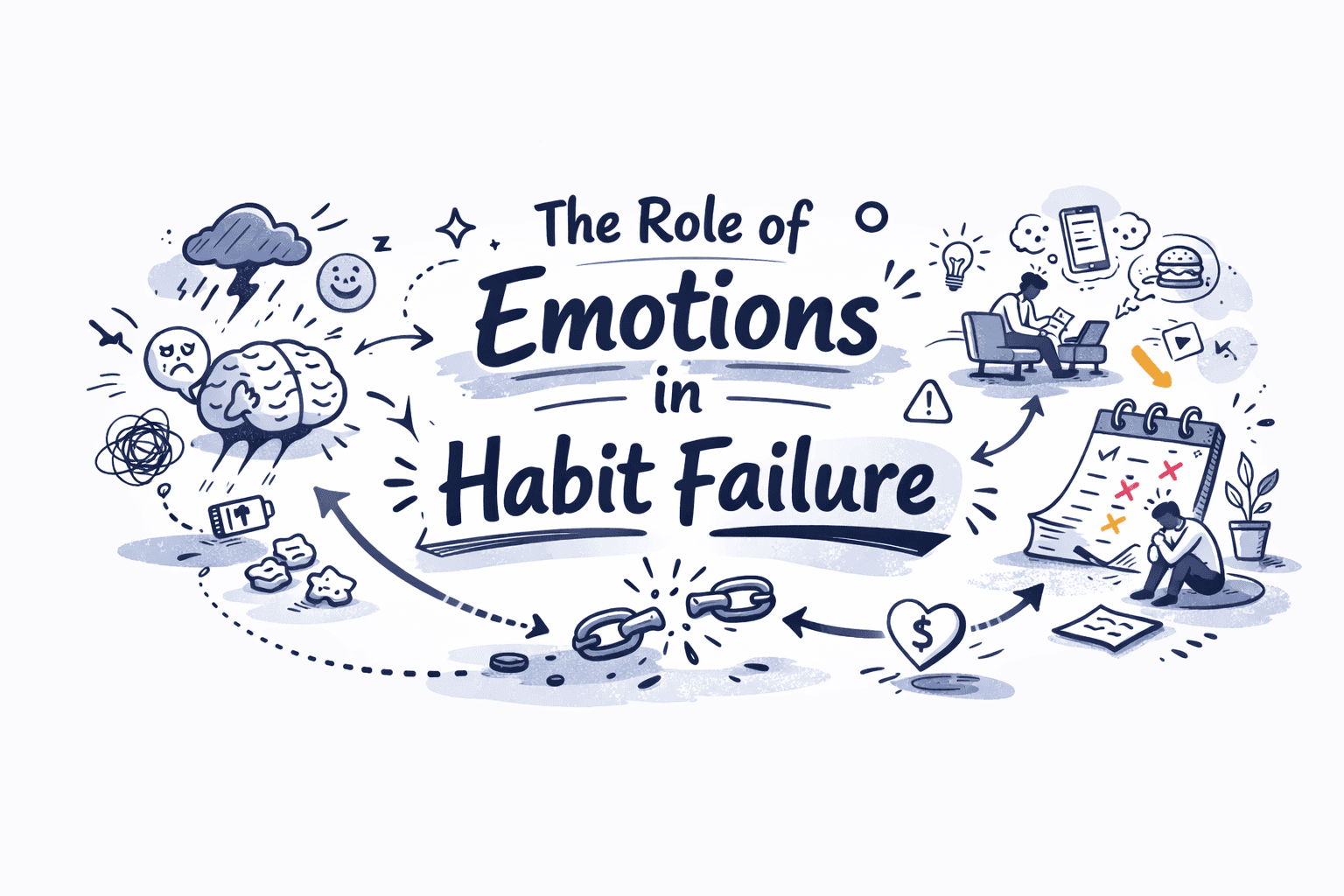
Your brain has two systems running in parallel. The prefrontal cortex handles deliberate, rational thinking — the part that made the commitment to exercise every morning. The limbic system handles emotion — and it's older, faster, and significantly more powerful than the prefrontal cortex when it's activated by stress or threat.
Research from Harvard Medical School shows that under stress, the brain shifts control away from the prefrontal cortex and toward the amygdala — the brain's threat detection center. This is the fight-or-flight response. And when it's running, your brain's top priority is not your morning routine. It's survival.
The habits that survive in this state are the ones already deeply encoded — your oldest, most automatic behaviors. The ones you've had for years. Not the ones you've been building for thirty-two days.
Stress Makes Bad Habits Stronger and Good Ones Weaker
This is the cruel irony of emotional habit disruption: stress simultaneously makes bad habits more tempting and good habits harder to maintain.
A 2013 study from the University of Southern California found that stress causes people to default to habitual behavior — but not the habits they want. Specifically, stress strengthened automatic behaviors regardless of whether those behaviors were good or bad. People who habitually ate healthy food ate more healthily under stress. People who habitually ate junk food ate more junk food under stress.
The behavior that wins under stress is whichever one is more deeply encoded. And for most people, the bad habits are older and more automatic than the good ones they're still trying to build.
This is why stress doesn't just pause your progress — it actively reverses it. The emotional brain reaches for the familiar, the comforting, the automatic — and for most of us, that means the habits we've spent years trying to break, not the ones we've been building for a few weeks.
Understanding this changes everything. When you relapse into an old habit during a hard week, you haven't failed. You've experienced a completely predictable neurological response to stress. The question isn't why it happened — it's what you build to prevent it next time.
Emotional Triggers Are Hidden Cues
Every habit runs on a cue-routine-reward loop. Most people think of cues as external — a time of day, a location, another behavior. But emotions are cues too. And they're among the most powerful ones.
Research from the American Psychological Association found that negative emotional states — stress, loneliness, boredom, anxiety — are consistent triggers for habitual comfort behaviors: overeating, drinking, scrolling, avoidance. These behaviors aren't random. They're well-worn responses to emotional cues, encoded over years of repetition.
The same mechanism works in reverse. Positive emotional states — calm, focus, confidence — act as cues for productive behavior. This is why good habits feel easier on good days and nearly impossible on hard ones. Your emotional state isn't just affecting your motivation. It's triggering completely different behavioral loops.
This connects directly to what we know about how context cues control 43% of your daily behavior — emotional context is one of the most powerful and least visible cues shaping what you do next.
Why "Just Push Through It" Fails
The standard advice for this problem is to try harder. Feel stressed? Push through it. Feeling low? Dig deep. Build discipline.
This advice fails for a simple biological reason: when your limbic system is running the show, willpower doesn't have the resources to override it. Studies on ego depletion from Florida State University found that emotional strain depletes the same cognitive resources as self-control — meaning a stressful day doesn't just make you feel bad, it literally uses up the mental energy you'd need to override impulses and stick to your plan.
You cannot out-willpower your emotional brain. It's not built to be outpowered that way. What you can do is build habits that are emotionally resilient — small enough, automatic enough, and flexible enough that they survive even when your emotional state is working against you.
This is exactly the principle behind the two-minute rule: a habit that only takes two minutes creates almost no resistance, even under emotional strain. You can journal one sentence even when you're overwhelmed. You can do two minutes of breathing even when you're anxious. The habit survives not because you pushed through — but because you made it small enough that your emotional state couldn't block it.
Building Emotionally Resilient Habits
The goal isn't to eliminate emotional disruption from your life — that's impossible. The goal is to build habits that are robust enough to survive it. Here's how:
Identify your emotional triggers in advance. What emotions reliably derail your habits? Stress? Loneliness? Frustration? Once you name them, you can plan for them. Create an if-then plan specifically for your emotional triggers: "If I'm feeling overwhelmed, then I will do the two-minute version of my habit instead of the full version."
Design a minimum viable version of every habit. Every habit you care about should have a stripped-down version that requires almost no effort. Not the optimal version — the survival version. This is what you do on hard days. It keeps the streak alive, the neural pathway warm, and your identity intact even when your emotional state is fighting against you.
Separate the emotion from the behavior. One of the most powerful reframes in habit psychology is this: you don't have to feel like doing something to do it. Research on behavioral activation — a clinical technique used in depression treatment — consistently shows that action precedes motivation, not the other way around. You don't wait until you feel good to exercise. You exercise, and then you feel good. The emotional state follows the behavior when you stop waiting for permission from it.
Use your good emotional states to build momentum. When you feel calm, focused, and energized, that's the time to deepen your habits — add a few minutes, add a layer, add a new complementary behavior. Build enough automaticity during the good periods that the habit can survive on its own during the hard ones.
Track honestly, even on bad days. There's something quietly powerful about opening your habit tracker app at the end of a genuinely hard day and checking something off — even the minimum version. It's proof that the emotional state didn't win. That the habit is bigger than the feeling. That you showed up anyway.
The Habit That Holds Is the One That Bends
The habits that last aren't the ones built during perfect conditions. They're the ones designed to survive imperfect ones.
Stress will come. Hard weeks will happen. Emotions will run hot and your prefrontal cortex will go quiet and your oldest, most comfortable behaviors will be right there waiting. That's not weakness. That's biology.
What separates the people who build lasting habits from the ones who keep restarting is not that they feel less stress. It's that they've built habits flexible enough to bend under pressure without breaking — and a tracking system honest enough to show them what's actually happening so they can adjust.
Emotions are not the enemy of your habits. They're the weather your habits have to be built to survive. Design accordingly.
Build habits tough enough to hold on your hardest days at kabitapp.com — and track every session with a daily habit tracker built to keep you honest when it matters most.

Learn more
Discover more from the latest posts.