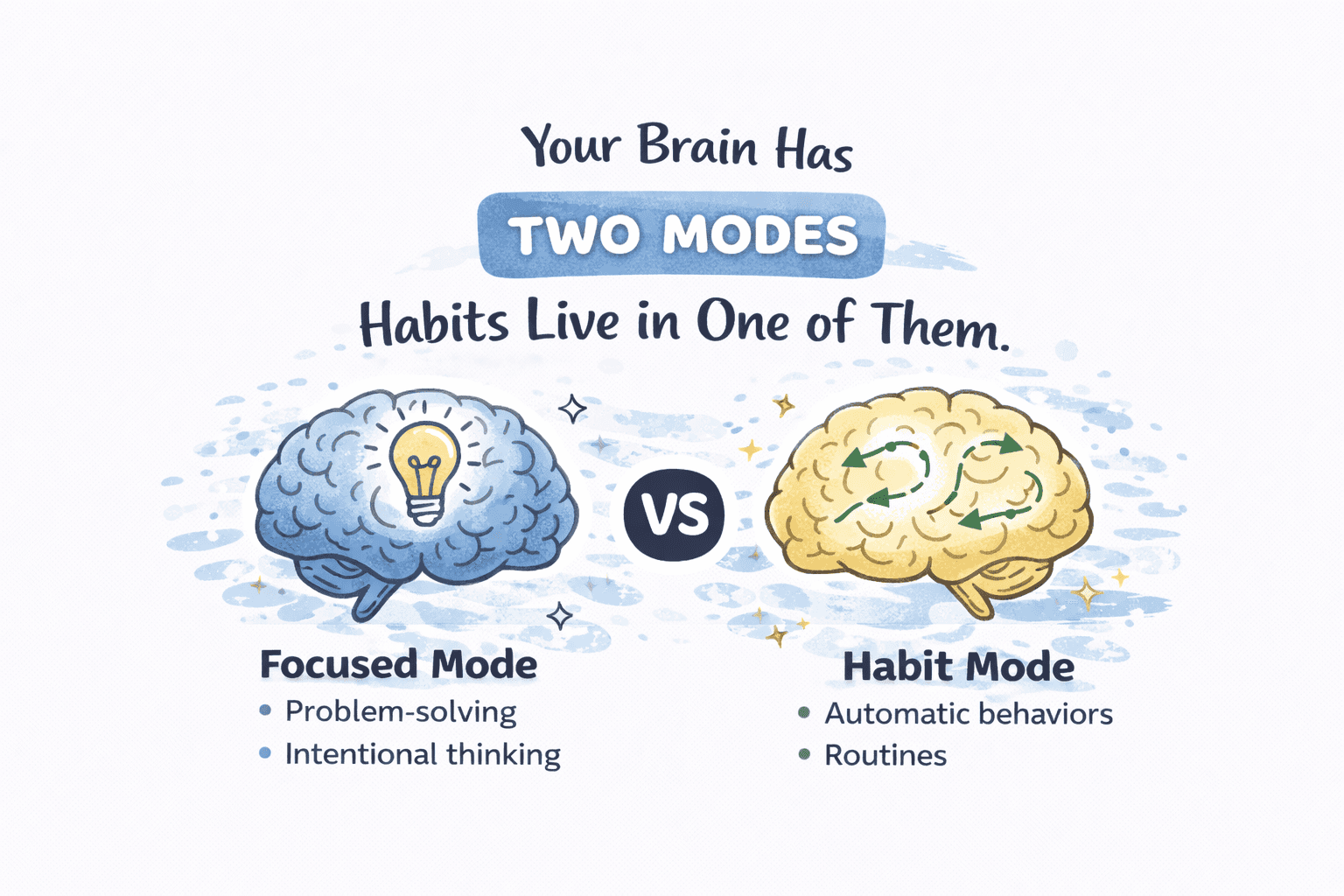
Your Brain Has Two Modes. Habits Live in One of Them.
Think about the last time you drove a familiar route and arrived with almost no memory of the journey. You stopped at red lights, navigated turns, avoided obstacles — and did all of it while your mind was somewhere else entirely.
That wasn't distraction. That was your brain running a completely different operating system than the one you use to make conscious decisions.
Every behavior you perform is controlled by one of two competing neural systems. One is deliberate, flexible, and exhausting to run. The other is automatic, efficient, and almost impossible to stop once activated. Habit formation is the process of transferring a behavior from the first system to the second — and a landmark study published in Nature Reviews Neuroscience by neuroscientists Henry Yin and Barbara Knowlton reveals exactly how that transfer happens inside your brain.
Understanding this changes how you build habits. Not in a vague, motivational way — in a specific, mechanistic way that explains why certain approaches work and others reliably fail.
The Two Systems Running Your Behavior
Deep beneath the cerebral cortex sits a cluster of structures called the basal ganglia. For most of the 20th century, neuroscientists considered this region primarily a motor control center. Yin and Knowlton's research — and the broader body of work it drew from — revealed something far more interesting: the basal ganglia has a key role in instrumental behavior, meaning learned behavior that is modified by its consequences, and within this system two fundamentally different types of behavioral control operate simultaneously. PubMed Central
The first is the goal-directed system. When you're learning something new — a route you've never driven, an exercise you've never done, a morning ritual you're trying to establish — this system is in charge. It's flexible and intelligent. It tracks the relationship between your action and its outcome, constantly asking: is what I'm doing actually producing the result I want? If the answer changes, the behavior changes. The goal-directed system lives primarily in the dorsomedial striatum, a region of the basal ganglia densely connected to the prefrontal cortex — the part of your brain responsible for planning and conscious deliberation.
The second is the habit system. Habits can be operationally defined as instrumental behavior that is impervious to changes in the value of the outcome and in the causal contingency between action and outcome — once a behavior becomes habitual, it fires automatically in response to a stimulus, regardless of whether the outcome is still desirable. PubMed Central The habit system lives in the dorsolateral striatum, connected to sensorimotor cortex rather than prefrontal cortex. It doesn't deliberate. It doesn't weigh consequences. It just executes.
Here is the critical insight: these two systems are always running in parallel, and they compete for control of your behavior. Which one wins depends on how many times you've repeated the behavior and under what conditions.
What Habit Formation Actually Is, Neurologically
Most people think of habit formation as building willpower or establishing motivation. The neuroscience tells a different story entirely.
The process of habit formation finds its neural correlate in a shift of control from the associative to the sensorimotor cortico-basal ganglia network — behavioral control moves from the goal-directed system to the habit system as a result of extended training. PubMed Central This shift is not metaphorical. It's a literal change in which part of your brain is running the behavior.
Early in learning, the goal-directed system dominates. The associative striatum is especially active during initial learning — it tracks the contingency between action and outcome and keeps behavior sensitive to changes in reward value. PubMed Central This is why new habits feel effortful: your prefrontal cortex is actively involved in every repetition, monitoring whether the behavior is producing the intended result and deciding whether to continue.
With enough repetitions in a stable context, something shifts. The sensorimotor striatum shows the opposite pattern — while the associative striatum is more critical to early learning, the sensorimotor striatum becomes more active after extended training, supporting the performance of habit-like behaviors and the transition from goal-directed to automatic performance. PubMed Central The behavior migrates from the deliberate system to the automatic system. Prefrontal involvement decreases. The habit begins to fire on cue, without conscious initiation.
This is what automaticity actually means: not that you've memorized something, but that a different part of your brain has taken over its execution.
The Devaluation Test — How Scientists Detect a True Habit
One of the most elegant aspects of Yin and Knowlton's framework is that it gives us a precise, testable definition of what a habit actually is — not just a behavioral description, but a neurological one.
The key test is called outcome devaluation. The idea is simple: if a behavior is still goal-directed, changing the value of its outcome should change the behavior. If the behavior has become a genuine habit, it will continue even when the outcome is no longer desirable.
An animal will perform a habitual act to obtain food even when it has eaten to satiation — goal-directed behavior, by contrast, is sensitive to the motivational state of the animal and stops when the outcome is no longer wanted. arXiv
This same principle applies to human habits. When you reach for your phone first thing in the morning, does that happen because you've consciously decided you want the outcome, or because the stimulus — waking up, the phone being nearby — automatically triggers the reach? If it would happen even on a morning when you've decided you don't want to check your phone, it's a habit. The behavior has migrated to the automatic system. Your prefrontal cortex's objections are simply overridden.
This is why habits are so hard to break through willpower alone. You're not fighting a decision — you're fighting an automated response running in a part of your brain that doesn't receive input from conscious deliberation. The stimulus fires the behavior before the deliberate system even registers that a choice was available.
Why Repetition Alone Isn't Enough
Here's where the neuroscience gets practically useful — and where it contradicts the most common habit-building advice.
Repetition is necessary for habit formation, but it's not sufficient on its own. Habit formation is strongly influenced by reinforcement schedules — training under ratio schedules produces goal-directed actions sensitive to outcome manipulations, whereas interval schedules typically generate habits insensitive to those changes. ADHD Evidence
In plain English: the conditions under which you repeat a behavior determine which system encodes it. Behaviors practiced with variable, unpredictable timing tend to migrate to the habit system faster. Behaviors practiced with constant, deliberate attention to outcomes tend to stay in the goal-directed system longer, even with extensive repetition.
Context stability matters just as much. The shift from goal-directed actions to stimulus-response habits typically occurs slowly as a result of extended training — but what drives the shift is the development of a strong association between an environmental stimulus and the behavior, so that the stimulus automatically elicits the response. arXiv Your brain is building a trigger. Without a consistent, reliable trigger — same time, same place, same preceding behavior — the stimulus-response association is slow to form, regardless of how many repetitions you accumulate.
This is the neurological explanation for why habit stacking works so well: you're deliberately borrowing the trigger reliability of an established behavior and using it to accelerate the formation of the stimulus-response association for a new one. The anchor behavior becomes the stimulus. The new behavior becomes the response. The basal ganglia does the rest.
The Practical Implications — What This Means for Building Habits
Understanding the two-system architecture of habit formation changes how you should approach building new behaviors.
In the early phase, reduce deliberation — don't increase it. The goal-directed system is in charge during early learning, which means every repetition involves your prefrontal cortex. That's metabolically expensive and depends on your cognitive resources being available. This is why complex habits with many decision points are harder to automate — they keep the prefrontal cortex involved longer. Simpler, more consistent behaviors migrate to the habit system faster. For a detailed breakdown of how to set up habits small enough to automate quickly, the beginner's guide to habit tracking covers the exact setup sequence.
Consistency of context matters more than consistency of effort. Your basal ganglia is learning to associate a stimulus with a response. If the stimulus varies — different times, different locations, different preceding behaviors — the association is slow to consolidate. Same cue, same response, repeated, is what the sensorimotor striatum needs to encode the habit. This is why habit stacking is neurologically sound: it provides a maximally consistent stimulus for the new behavior.
Track to stay in the system long enough. Before the transition to automaticity, a given behavior being learned remains sensitive to outcome — it requires conscious monitoring and deliberate continuation. Only after sufficient repetition in stable context does the behavior become independent of reward value and begin firing automatically. PubMed Central Most people quit during this window — after motivation fades but before automaticity arrives. Tracking your habit keeps the behavior alive through this gap by providing the small, immediate reward of a completed check-in, sustaining the repetitions the sensorimotor striatum needs.
The Flip Side — Why Bad Habits Are So Hard to Break
The same mechanism that makes good habits resilient makes bad ones stubborn.
Once a behavior has migrated to the sensorimotor striatum, it becomes largely impervious to outcome devaluation. You know the habit is bad. The prefrontal cortex has made a conscious decision to stop. But the stimulus still fires the behavior because the response is encoded in a system that doesn't consult conscious decisions.
The dorsal striatum and its cortical inputs have emerged as key players in encoding behavioral automaticity — and disordered functioning of these neural circuits underlies neuropsychiatric conditions including obsessive-compulsive disorder and addiction, where automated behaviors persist despite conscious desire to stop. American Psychiatric Association
This is not a character flaw. It's a design feature of a system built for efficiency. The habit system was never meant to be easily overridden by conscious intention — that would defeat its purpose. Breaking an established habit requires either changing the stimulus so the trigger doesn't fire, or building a competing response that becomes associated with the same stimulus. Willpower alone — simply deciding not to do the behavior — consistently fails because it's trying to use the deliberate system to override the automatic one. The deliberate system loses that fight more often than not.
What Habit Formation Really Is
The simplest summary of everything Yin and Knowlton's research reveals: building a habit is not about motivation, discipline, or identity. It's about transferring a behavior from an expensive, deliberate neural system to an efficient, automatic one.
That transfer requires consistent repetition in stable context over enough time for the sensorimotor striatum to encode the stimulus-response association. Everything else — motivation, rewards, accountability — is scaffolding to keep you repeating the behavior long enough for the transfer to occur.
Once you understand that, the question changes from "how do I stay motivated?" to "how do I set up the conditions for the transfer to happen as quickly as possible?" And the answers to that question — small behaviors, stable context, consistent cues, patient repetition — are exactly what the definitive guide to habit tracking is built around.
When you're ready to start the process, kabitapp.com was built on these exact principles — and the free habit tracker app gives you the system to keep the repetitions going long enough for your basal ganglia to do its job.
🎯 Key Takeaways
Every behavior is controlled by one of two competing brain systems: a deliberate goal-directed system in the dorsomedial striatum, and an automatic habit system in the dorsolateral striatum — habit formation is the neurological transfer of a behavior from the first to the second
Repetition alone doesn't cause the transfer — context stability matters equally, because the habit system encodes a stimulus-response association, not just the behavior itself
Bad habits are hard to break for the same reason good habits are resilient: once encoded in the sensorimotor striatum, behaviors fire automatically in response to their stimulus, largely bypassing conscious deliberation

Learn more
Discover more from the latest posts.