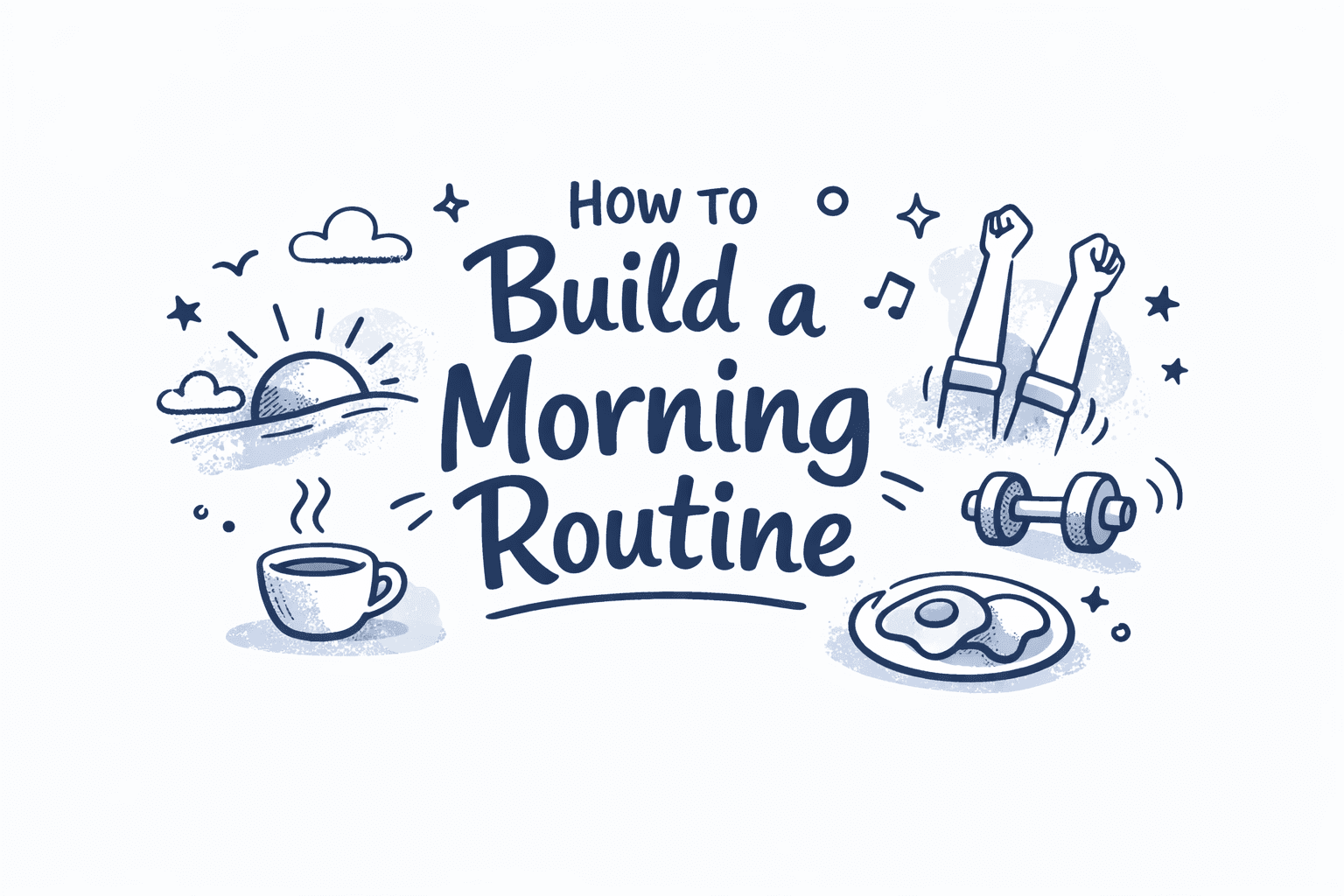
How to Build a Morning Routine That Actually Sticks (Science-Backed Steps)
Everyone has advice about morning routines, Wake up at 5 AM, Cold showers, Journaling, A green smoothie, An hour of meditation before the world wakes up. It sounds aspirational — and for most people, completely unsustainable.
Here's the thing: the goal isn't to copy someone else's morning. It's to build one that fits your life, works with your biology, and becomes automatic enough that you don't have to fight yourself to do it every day.
The science of habit formation makes this clearer than most productivity influencers will admit. A great morning routine isn't about discipline. It's about design.
Why Mornings Are the Best Time to Build Habits
Your brain operates differently in the morning than it does later in the day. Cortisol — the hormone responsible for alertness — naturally peaks in the first hour after waking. This isn't stress; it's your body priming you for focused action. Cognitive clarity is higher, distractions are fewer, and decision fatigue hasn't set in yet.
Research shows that 90% of Americans agree their morning routine sets the tone for their mental wellness for the rest of the day — and the science backs that feeling up. According to the Journal of Behavioral Medicine, people who follow structured morning routines report 32% higher daily energy and improved sleep quality compared to those who start their days reactively.
The morning is also when habit formation is most efficient. Neural pathways strengthen most reliably when behaviors happen at consistent times with consistent cues — and few things are more consistent than waking up. As we covered in our piece on keystone habits, morning behaviors have an outsized ripple effect on the rest of your day, making them the single highest-leverage place to invest in habit building.
Step 1: Design Around Your Chronotype, Not Someone Else's
Before you decide what your morning routine looks like, you need to accept one thing: there is no universally "correct" time to wake up. Research at the University of Pittsburgh found that when your sleep is misaligned with your chronotype — such as waking up early when you're naturally a night owl — it produces a kind of social jet lag associated with poor metabolic health.
If you're a natural early riser, a 5:30 AM start works with your biology. If you're not, forcing it works against it. What matters isn't the hour — it's the consistency. Research by chronobiologist Dr. Till Roenneberg shows that irregular wake times disrupt circadian rhythms, leading to poor sleep quality and reduced energy. Waking at the same time — even on weekends — helps regulate your internal clock.
Pick a wake time you can hit seven days a week. That consistency, not the number on the clock, is what drives long-term habit formation.
Step 2: Protect the First 30 Minutes
Most people hand over the first moments of their day to their phone. Email, news, social media — before you've even made coffee, your attention is already fractured and your stress response is activated.
Not checking your phone first thing in the morning is one of the most effective ways to decrease stress levels and improve focus throughout the day. The reasoning is simple: reactive inputs trigger reactive states. If your first act is responding to the world, you spend the rest of the morning catching up rather than leading.
Use those first 30 minutes intentionally. Even something as simple as drinking a glass of water, stepping outside for natural light, or sitting quietly for five minutes creates a buffer between sleep and the demands of the day. That buffer is where your morning routine lives.
Step 3: Build Small, Then Stack
This is where most people go wrong. They design a two-hour morning routine on a Sunday and try to execute it Monday. By Wednesday, it's gone.
Start with one habit. Make it small enough that you genuinely cannot fail. Five minutes of stretching. One page of journaling. Ten deep breaths. The goal in the first two to four weeks isn't transformation — it's proof of concept. You're teaching your brain that this routine happens every morning, without negotiation.
Once that anchor habit feels automatic, add the next one using habit stacking — attaching a new behavior directly to an existing one. "After I make coffee, I will write one sentence" is more powerful than "I will journal every morning," because it uses an existing trigger rather than relying on memory or motivation. Research from the British Psychological Society found that people who used habit stacking reported 64% higher success rates than those who tried to establish standalone habits.
Our deeper guide on habit stacking walks through exactly how to build these chains effectively.
Step 4: Include at Least One Body-Based Habit
The research on morning movement is consistent and compelling. Studies show that 20 minutes of morning movement enhances mood and reduces anxiety more effectively than later workouts, especially when done consistently.
You don't need a full gym session. A 10-minute walk, five minutes of yoga, or even a set of push-ups activates your body, raises your heart rate, and signals to your brain that the day has begun. Physical activity also accelerates the clearance of adenosine — the chemical that makes you feel groggy — more effectively than a second cup of coffee.
Morning light exposure is equally powerful. Getting outside within the first 30 to 60 minutes of waking supports better energy, sharper thinking, and healthier sleep by regulating melatonin and boosting serotonin. Any one of these body-based habits is enough to shift your baseline for the rest of the day. Combining two or three of them compounds the effect significantly.
Step 5: Track It — Even Minimally
A morning routine only becomes a routine when you repeat it consistently enough that it stops requiring effort. Until then, you need a system to keep yourself accountable without adding friction.
Tracking doesn't have to be elaborate. A simple yes/no checkmark for each habit takes ten seconds and creates the visual feedback loop your brain needs to stay motivated. Each completed checkmark triggers a small dopamine release, reinforcing the behavior and making you more likely to repeat it tomorrow. Over time, the streak itself becomes a reason to show up.
This is the principle behind how Kabit is built — a clean, simple tracker that makes your morning routine visible and satisfying to complete. Download Kabit and set up your morning habits as a daily stack. Within a few weeks, checking in will feel as automatic as brushing your teeth.
The Routine Isn't the Point — The Consistency Is
The best morning routine is the one you actually do. Not the most optimised, not the most impressive, not the one with the most habits. The one that happens, day after day, without a fight.
A 2023 study found that structured morning routines boost productivity by 25% and reduce stress by 20% — but those numbers only apply to routines people actually maintain. A modest routine done consistently will always outperform an ambitious one done sporadically.
Start tomorrow. Not with a perfect routine — with a first step. One habit, at one time, attached to something you already do. Give it two weeks before you judge it. Track it so you can see it working.
Your mornings are already happening. The only question is whether you're designing them or reacting to them.

Learn more
Discover more from the latest posts.