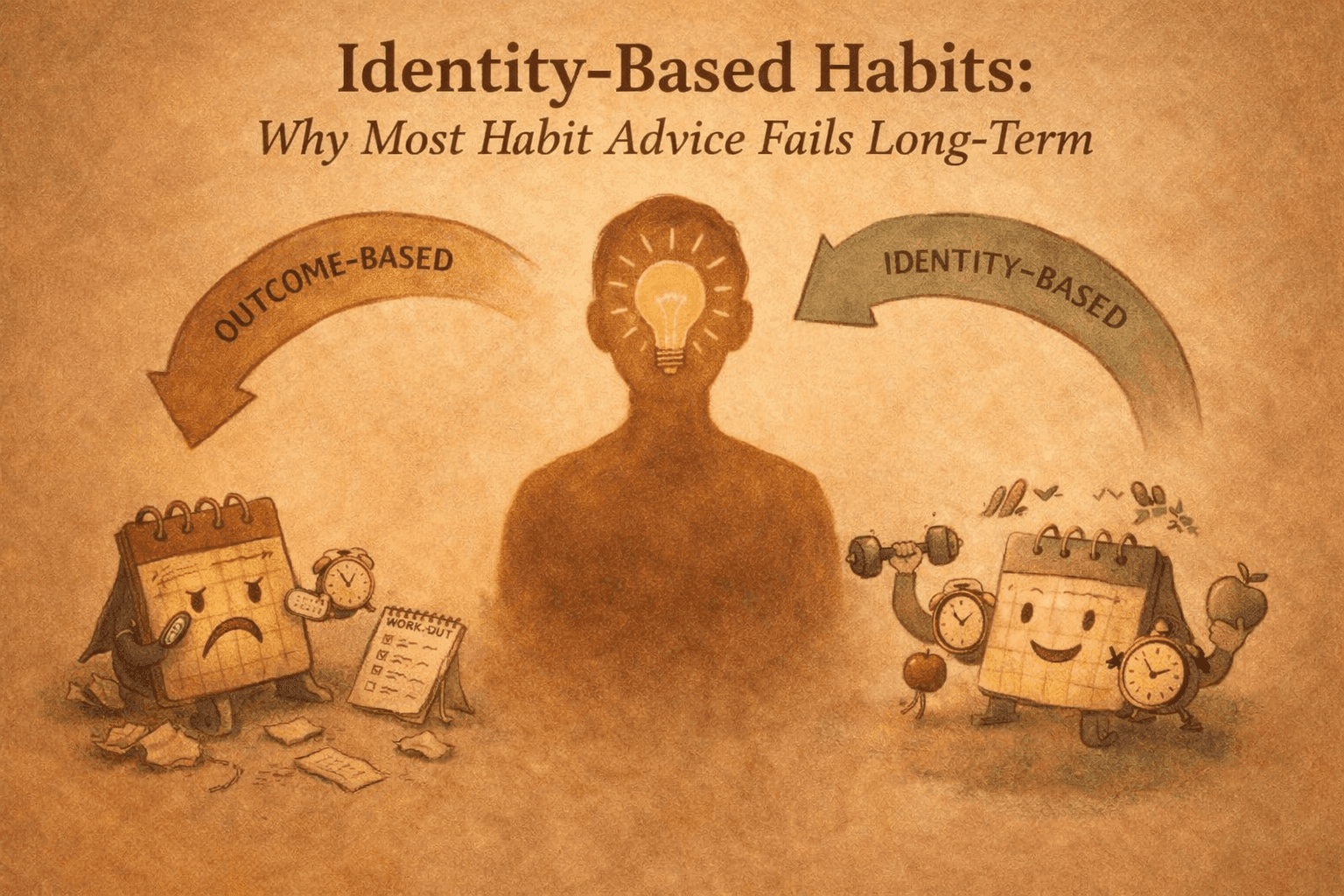
Identity-Based Habits: Why Most Habit Advice Fails Long-Term
Most habit advice sounds reasonable on the surface.
Wake up early.
Stay consistent.
Build discipline.
Don’t break the streak.
Yet most people still fail to build habits that last.
After watching thousands of users try (and restart) habit streaks, I’ve come to a simple conclusion:
The problem isn’t discipline. It’s identity.
Habits don’t stick because they’re logically correct.
They stick when they reinforce who you believe you are.
Motivation Is a Terrible Foundation for Habits
Motivation feels powerful, but it’s unreliable.
It spikes when life is calm and disappears when work gets chaotic, health dips, or priorities shift. Most habit systems collapse the moment motivation drops — which is inevitable.
This is why motivation-based habits fail silently. You don’t quit in one dramatic moment. You just… stop.
Miss one day.
Then another.
Then the habit fades into “I’ll restart next Monday.”
If you’ve experienced this cycle, it doesn’t mean you lack willpower. It means your habit was built on a fragile trigger.
A better question to ask is not “How do I stay motivated?”
It’s “Who is this habit helping me become?”
What Identity-Based Habits Actually Mean
An identity-based habit starts with a subtle internal shift.
Instead of saying:
“I want to read more”
“I want to work out daily”
“I want to meditate”
You start with:
“I am someone who reads regularly”
“I am someone who doesn’t skip movement”
“I am someone who protects their mental clarity”
The habit becomes evidence, not effort.
Each repetition isn’t about completing a task — it’s about casting a vote for the type of person you believe you are.
This is why small habits compound faster than ambitious ones.
They’re easier to repeat, and repetition is what reshapes identity.
I’ve written earlier about how tiny actions quietly compound over time in How Small Habits Compound Over Time — identity-based habits are the psychological reason that compounding works.
Why Tracking Alone Doesn’t Change Behaviour
Habit trackers are useful, but tracking alone doesn’t create transformation.
If tracking becomes the goal, the habit becomes mechanical:
You check the box
You protect the streak
You feel productive
But identity doesn’t change.
This is why many people maintain streaks yet feel disconnected from the habit itself. Once the streak breaks, the habit disappears.
The shift happens when tracking answers a different question:
“What does this habit say about me today?”
When used correctly, tracking reinforces identity rather than replacing it. This is also why many people feel frustrated after using habit trackers without reflection
The Quiet Power of Showing Up Imperfectly
One of the most underrated aspects of identity-based habits is permission to be imperfect.
If your identity is:
“I am someone who values movement”
Then:
A 10-minute walk counts
Stretching counts
A lighter day still counts
You’re not protecting a streak.
You’re protecting a self-image.
This reduces all-or-nothing thinking — the biggest killer of consistency.
Ironically, lowering the bar increases long-term standards. People who show up imperfectly show up more often. And frequency beats intensity every time.
A Simple Framework to Build Identity-Based Habits
This is a framework I personally use and recommend:
1. Name the identity
Not the habit.
❌ “I want to journal daily”
✅ “I am someone who reflects before reacting”
2. Choose the smallest visible action
Something that:
Takes under 5 minutes
Can be done on bad days
Feels almost too easy
3. Track for awareness, not pressure
Tracking should answer:
“Did I show up as that person today?”
Not:
“Did I perform perfectly?”
4. Let consistency change self-trust
Identity changes quietly. You won’t feel different immediately. But after enough evidence, your self-image updates automatically.
At that point, discipline becomes optional.
The Long-Term Effect Most People Miss
Identity-based habits don’t just change behavior.
They change decision-making.
When identity shifts:
You don’t debate whether to act
You don’t rely on motivation
You don’t need external pressure
The habit becomes the default, not the exception.
This is also why people who build habits correctly often say, “I don’t even think about it anymore.”
That’s not discipline — that’s alignment.
Final Thought
If you’re struggling to stay consistent, stop adding more rules.
Instead, ask:
“What kind of person am I trying to become — and what’s the smallest action that proves it today?”
Build habits that protect identity, not streaks.
Everything else follows.

Learn more
Discover more from the latest posts.