Streak App: The Psychology Behind the Number That Keeps You Showing Up
I have a confession about streaks: I once cut short a holiday trip because I didn't want to break a 94-day reading streak.
Looking back, that was the streak working against me rather than for me. But it also revealed something important — a simple incrementing number had become more motivating than anything else I'd tried. No accountability partner, no external reward, no motivational quote had ever made me reschedule travel plans. A number on a phone screen did.
Understanding why that happens — and how to make it work for you without letting it work against you — is what this article is about.
What a Streak App Actually Is
A streak app is any application that tracks consecutive days of a completed behavior and displays that count visibly. The streak is the number. The app is the system that keeps it honest and makes it visible.
The concept predates apps entirely. Jerry Seinfeld famously described marking an X on a paper calendar for every day he wrote jokes — the rule being simply "don't break the chain." The psychology worked on paper. Apps just made it more accessible, more precise, and considerably harder to ignore.
Maintaining a streak can become a goal in and of itself, independent from the behavior it's based on — providing structure that simplifies thinking and decision-making, effectively removing the daily negotiation about whether to act. American Psychiatric Association That last part is the key. The most exhausting part of building any habit is the daily internal debate about whether to do it today. A streak eliminates that debate. You have a streak to protect. The decision has already been made.
The Two Psychological Mechanisms That Make Streaks Work
Streaks aren't motivating because they're clever gamification. They're motivating because they exploit two of the most deeply wired features of human decision-making.
Mechanism 1 — Loss aversion
At the heart of streak motivation lies loss aversion — the psychological principle that losses feel roughly twice as painful as equivalent gains feel good. ADHD Evidence Once you have a streak, it feels valuable. You own it. It's yours. arXiv A 5-day streak has mild pull. A 50-day streak has considerable pull. A 200-day streak feels almost sacred — not because you're more motivated, but because you're defending an investment.
Duolingo explains how loss aversion contributes to a user's reluctance to break a long streak, even on their laziest days — in a way, a streak can turn into a habit when loss aversion settles in. arXiv This is the mechanism working exactly as intended: the streak keeps you showing up on the days when motivation has completely evaporated, which are precisely the days that determine whether a habit survives long enough to become automatic.
Mechanism 2 — Dopamine anticipation
Streaks trigger dopamine release through the anticipation of rewards rather than the rewards themselves — the anticipation of maintaining a streak creates excitement and engagement that transforms a simple counter into a powerful motivation system. PubMed Central
The number going up feels good. The prospect of it going up tomorrow feels good. The dread of it resetting to zero feels bad — bad enough to override the inertia of skipping. Together, these two forces create a motivational system that doesn't depend on how inspired you feel on any given morning.
Research published in 2025 across six studies with nearly 4,500 participants found that people complete more work when compensated with streak incentives than with larger, stable rewards. ADHD Evidence A streak isn't just a counter. In behavioral terms, it outperforms cash.
Why Streaks Can Backfire — And How to Prevent It
The same mechanisms that make streaks powerful can make them destructive when the design is wrong or the mindset is off.
A study in Health Psychology found that people who broke a weight-loss streak were 47% more likely to binge eat afterward than those who never tracked a streak — the "zero" triggered a "what the hell" abandonment response. PubMed Central This is loss aversion working in reverse: once the streak is gone, the psychological anchor disappears with it. The invested effort feels lost. The motivation to continue collapses.
Research has documented counterproductive effects of gamification, where streak mechanics can lead to obsessive behavior, unnecessary stress, or anxiety — the crushing psychological impact of breaking a streak can cause people to give up entirely rather than start over. ADHD Evidence
Three design failures cause most streak backfires:
The perfectionism trap. When a streak demands an all-or-nothing record, a single miss feels catastrophic. The solution isn't to stop tracking streaks — it's to build a recovery system. What to do when you break a habit streak covers this in full, but the short version is: one miss is an incident, never two in a row is the rule.
The wrong minimum. Ability compensates for the limitations of motivation — in this context, ability means the ease of action, where the effort required is so low that it's unrealistic to say it isn't possible. Most apps intentionally use this: Apple Fitness needs you to stand for one minute in an hour, Duolingo only needs one completed lesson. arXiv If your streak requires a full 45-minute workout every single day, you will break it. If it requires ten push-ups, you almost never will. Set the minimum at what's achievable on your worst day.
The streak becoming the point. Research found a risk of technology dependence — participants depended on reminders and streaks to continue repeating behaviors, tying the habit to in-app triggers rather than genuine automaticity. ADDA A streak is training wheels. The goal is to eventually not need it — to reach the automaticity where the behavior fires on its own. When protecting the number starts overriding the purpose of the behavior (skipping rest when injured to maintain a fitness streak, for example), the tool has become counterproductive.
What to Look for in a Streak App
Not all streak implementations are equal. The difference between one that helps you build real habits and one that creates anxious number-protection is almost entirely in the design decisions.
Honest streak display without shame mechanics. The streak counter should show your actual consecutive days clearly — but missing a day shouldn't trigger punishing notifications or guilt-based messaging. A good streak system should gravitate towards intrinsic motivation with careful use of extrinsic elements — reminding users of how far they've come, not threatening them with what they might lose. arXiv
Flexible minimum completion. The best streak apps let you define what "done" means for each habit — so a day where you did the minimum viable version still counts. This is how streaks stay alive through the hardest phases of habit formation without demanding perfection.
Recovery without penalty theater. A missed day should be visible in your history — honesty matters — but the app should make it easy to resume the streak immediately rather than treating the miss as a catastrophic reset that erases your identity as someone who does the habit.
Reminders that function as genuine cues. Without prompts, most new users forget to keep going — even long-time users benefit from prompts, though most are already locked inside the habit loop. arXiv The reminder shouldn't be a generic daily ping — it should arrive at the moment contextually closest to when you'd do the habit, functioning as an actual behavioral cue rather than background noise.
How I Use Streaks in Kabit
When I built Kabit, streaks were a deliberate design decision — not as a gamification layer, but as a behavioral tool that needed to be implemented carefully.
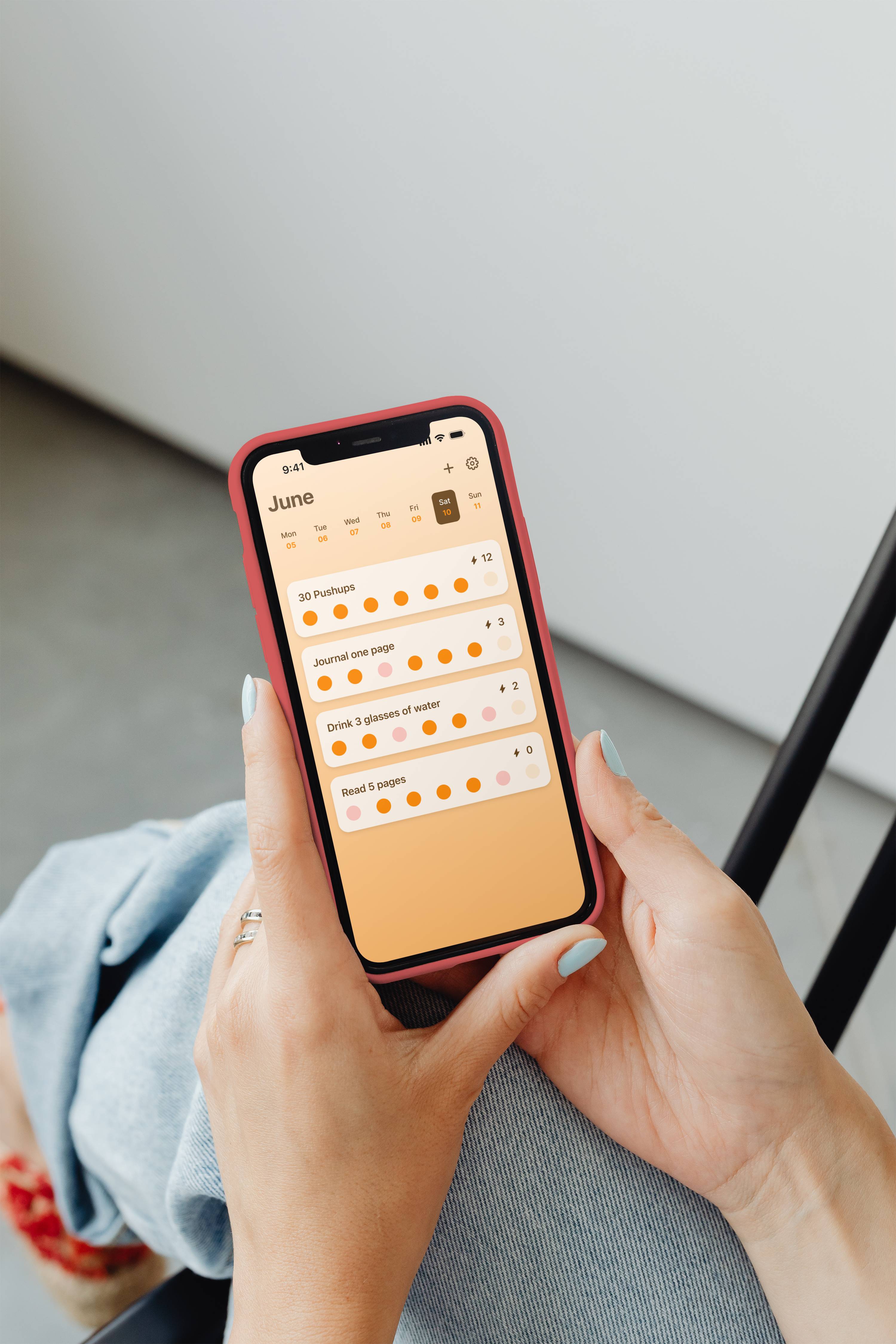
The streak counter is front and center because visibility matters. You need to see the number clearly to feel the loss aversion that makes it work. But the system is built around the philosophy that a streak represents consistent effort, not robotic perfection. Your history is honest — it shows every day, including misses — but the design encourages immediate recovery rather than treating a break as an identity failure.
The reminder system is customizable by habit, with text you write yourself, because a reminder that sounds like you is more likely to function as a genuine behavioral cue than a generic system notification.
And the minimum completion threshold is yours to define — because a daily habit tracker that demands perfect execution on every day will lose users at exactly the moments when showing up matters most.
The result, based on what users tell me, is streaks that feel motivating rather than anxious — numbers worth protecting because they represent something real, not just a score to defend.
The Right Relationship With Your Streak
To turn a streak into a habit, you should make it easy to repeat the behavior — get yourself to repeat something often enough in the same context, and ultimately it might become automatic. ADDA
That's the goal. The streak is a scaffold for getting there — not the destination itself. Use it to survive the plateau phase, the weeks between days 14 and 45 where motivation has dipped but automaticity hasn't arrived. Let loss aversion carry you through the days when you'd otherwise skip. But keep the minimum low, build in recovery, and remember that the number is serving the behavior — not the other way around.
For the full science on what's happening neurologically as your streak builds toward automaticity, how long it really takes to build a habit covers the complete timeline. And if you're ready to start building streaks that actually stick, kabitapp.com is where most people begin.
🎯 Key Takeaways
Streaks work through two deeply wired psychological mechanisms: loss aversion (the pain of losing a streak is twice as motivating as the pleasure of gaining) and dopamine anticipation — together they eliminate the daily decision about whether to show up
The three ways streaks backfire: perfectionism with no recovery system, minimums set too high to survive hard days, and the streak becoming more important than the behavior it's meant to support
A good streak app shows your history honestly, keeps the completion threshold flexible, makes recovery easy, and uses reminders as genuine behavioral cues — not guilt delivery systems

Learn more
Discover more from the latest posts.