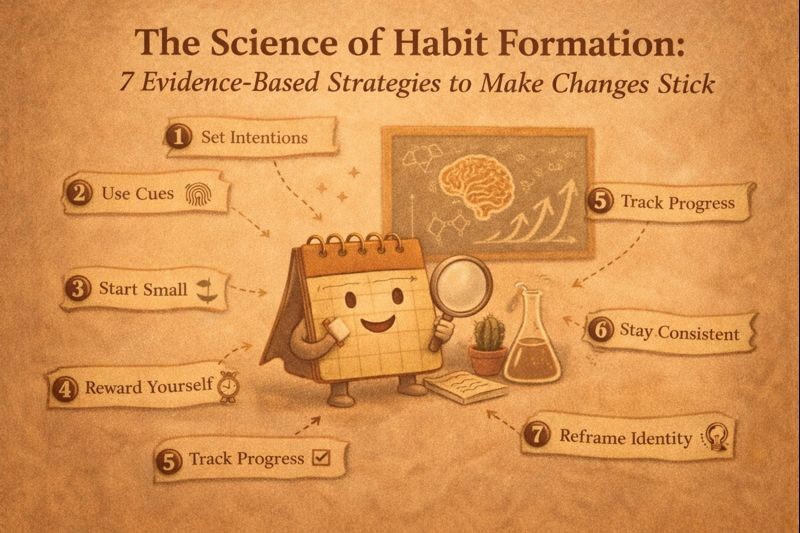
The Science of Habit Formation: 7 Evidence-Based Strategies to Make Changes Stick
We've all been there. It's January 15th, and that ambitious New Year's resolution to exercise every morning has already faded into a distant memory. Or you've downloaded yet another productivity app, only to abandon it within weeks. The problem isn't your willpower—it's that you're missing the science behind how habits actually form.
Understanding habit formation isn't just about motivation or discipline. It's about working with your brain's natural processes rather than against them. Research shows that habits account for about 40% of our daily behaviors, which means mastering habit formation is essentially learning to program your autopilot for success.
Let's explore the evidence-based strategies that actually work, backed by research from leading behavioral scientists and productivity experts.
1. Start Ridiculously Small: The Power of Atomic Habits
James Clear, author of the bestselling book Atomic Habits, emphasizes a counterintuitive truth: the best way to build a new habit is to start so small it feels almost laughable. He calls these "atomic habits"—tiny changes that compound into remarkable results over time.
The research backs this up. A study published in the European Journal of Social Psychology found that it takes an average of 66 days for a new behavior to become automatic, but the key is consistency, not intensity. Rather than committing to an hour-long workout, start with two push-ups. Instead of meditating for 20 minutes, begin with a single conscious breath.
Why does this work? Because your brain's resistance to change is proportional to the size of the change. A two-minute habit bypasses your mental resistance entirely. Once you're consistently doing the tiny version, scaling up becomes natural.
Action step: Choose one habit you want to build and reduce it to a two-minute version. Want to read more? Commit to reading one page. Want to journal? Write one sentence. The goal is consistency, not heroics.
2. Design Your Environment: Make Good Habits Inevitable
Stanford behavior scientist BJ Fogg has spent decades studying what makes habits stick. His research reveals a powerful truth: behavior is shaped more by our environment than by our motivation. This is what he calls "designing for behavior" in his Tiny Habits methodology.
Think about it—you don't need willpower to check your phone when it pings with a notification. The environment (the notification) triggers the behavior automatically. The same principle can work for positive habits.
Productivity expert James Clear suggests using "environment design" to make good habits the path of least resistance. Want to exercise more? Sleep in your workout clothes. Want to eat healthier? Put fruits at eye level and hide the junk food. Want to read before bed? Place a book on your pillow each morning.
Research from Duke University found that context-dependent repetition is crucial for habit formation. When you perform a behavior in the same environment repeatedly, the environment itself becomes a trigger for the behavior.
Action step: Identify one environmental change that would make your desired habit easier. Rearrange your physical space to support the behavior you want to encourage.
3. Use Habit Stacking: Leverage Existing Routines
One of the most effective techniques for building new habits is to attach them to behaviors you already do consistently. This concept, popularized by James Clear but rooted in decades of behavioral psychology, is called "habit stacking."
The formula is simple: After [CURRENT HABIT], I will [NEW HABIT].
For example:
After I pour my morning coffee, I will meditate for one minute
After I sit down at my desk, I will write one sentence in my journal
After I put on my running shoes, I will do five push-ups
This works because existing habits have already carved neural pathways in your brain. By attaching new behaviors to these established patterns, you're essentially piggybacking on your brain's existing autopilot.
The Power of Habit author Charles Duhigg calls this the "habit loop"—every habit has a cue, a routine, and a reward. When you stack habits, you're using an existing routine's completion as the cue for your new behavior.
Action step: List three habits you do every day without thinking. Choose one and identify a new tiny habit you could stack onto it.
4. Track Your Progress: The Streak Effect
There's something psychologically powerful about not wanting to break a streak. Jerry Seinfeld famously used this principle with his "Don't Break the Chain" method for writing daily. He marked a big X on a calendar for every day he wrote jokes, and his only job was to not break the chain.
This isn't just anecdotal—it's backed by behavioral science. The Zeigarnik Effect shows that people remember uncompleted or interrupted tasks better than completed ones. When you have an active streak, your brain treats breaking it as an incomplete task, creating psychological tension that motivates you to continue.
Visual progress tracking provides immediate feedback and creates what researcher Teresa Amabile calls "the progress principle"—even small wins can boost motivation and perception of success.
With Kabit's streak counter, you're tapping into this psychological principle. Watching your numbers grow creates positive reinforcement that makes consistency feel rewarding. The visual representation of your progress becomes a powerful motivator.
Action step: Choose a tracking method that excites you—whether it's Kabit's digital streak counter, a physical calendar, or a simple checkmark system. The key is making your progress visible.
5. Focus on Identity, Not Outcomes
One of the most profound insights in habit science comes from understanding the difference between outcome-based habits and identity-based habits. Most people approach change backward—they focus on what they want to achieve rather than who they want to become.
As James Clear explains, there are three layers of behavior change:
Outcomes (what you get)
Processes (what you do)
Identity (what you believe)
The most effective way to build lasting habits is to focus on the identity level. Instead of "I want to run a marathon" (outcome), think "I am a runner" (identity). Your behaviors then flow naturally from this identity.
Research in social psychology supports this approach. Studies show that people are more likely to engage in behaviors that align with how they see themselves. When someone identifies as "a healthy person," choosing a salad over fries becomes easier because it's consistent with their self-concept.
Action step: Reframe your habit in terms of identity. Instead of "I want to exercise," try "I am someone who moves their body daily." Notice how this subtle shift changes your relationship with the behavior.
6. Master the Two-Minute Rule: Beat Procrastination Before It Starts
When you're trying to build a new habit, procrastination often strikes before you even begin. The antidote? The two-minute rule, which states that any new habit should take less than two minutes to do.
This isn't about limiting yourself to two minutes forever—it's about mastering the art of showing up. As behavioral researchers at Stanford's Behavior Design Lab have found, the hardest part of any habit is starting. Once you've started, continuing becomes significantly easier.
The two-minute rule works because it:
Overcomes initial resistance
Creates a gateway to deeper engagement
Builds the identity of someone who shows up consistently
Real habits always start small. You can't build a reading habit by committing to read for an hour every night—you're setting yourself up for failure. But you can commit to reading one page. Often, you'll read more, but even if you don't, you've reinforced the habit.
Action step: For every habit you're trying to build, identify the two-minute version. This becomes your minimum viable commitment—the baseline you hit even on your worst days.
7. Prepare for Obstacles: Implementation Intentions
One of the most robust findings in habit research is the power of implementation intentions—essentially, planning for obstacles before they arise. Psychologist Peter Gollwitzer's research shows that people who use "if-then" planning are 2-3 times more likely to follow through on their goals.
The format is: "If [OBSTACLE], then I will [SPECIFIC ACTION]."
For example:
If it's raining, then I will do a 10-minute indoor workout instead of running
If I'm too tired to write in the evening, then I will write for 5 minutes in the morning
If I miss my meditation, then I will do it during my lunch break
This technique works because it removes the need for decision-making in the moment. When the obstacle occurs, you already know exactly what you'll do. You've essentially created a habit for handling obstacles.
Research from the University of Pennsylvania found that implementation intentions significantly improved habit adherence, particularly when combined with other behavioral strategies.
Action step: Identify the three most likely obstacles to your new habit. For each one, create an if-then plan that specifies exactly what you'll do when that obstacle appears.
Building Habits That Actually Stick
The science of habit formation reveals that sustainable change isn't about dramatic transformation—it's about small, consistent actions compounded over time. By starting ridiculously small, designing your environment, stacking habits onto existing routines, tracking your progress, focusing on identity, using the two-minute rule, and preparing for obstacles, you're working with your brain's natural tendencies rather than against them.
Remember, habits aren't formed in a day, but they are formed daily. The goal isn't perfection—it's consistency. Every time you show up, even in the smallest way, you're casting a vote for the type of person you want to become.
With the right strategies and tools like Kabit to track your progress, you can transform your daily routines into powerful systems that support your goals. The question isn't whether you can change—it's whether you're ready to start small and stay consistent.
What's the one tiny habit you'll start today?
Ready to put these strategies into action? Download Kabit to track your habits, build streaks, and watch your consistency grow with visual progress indicators that make showing up every day feel rewarding.

Learn more
Discover more from the latest posts.