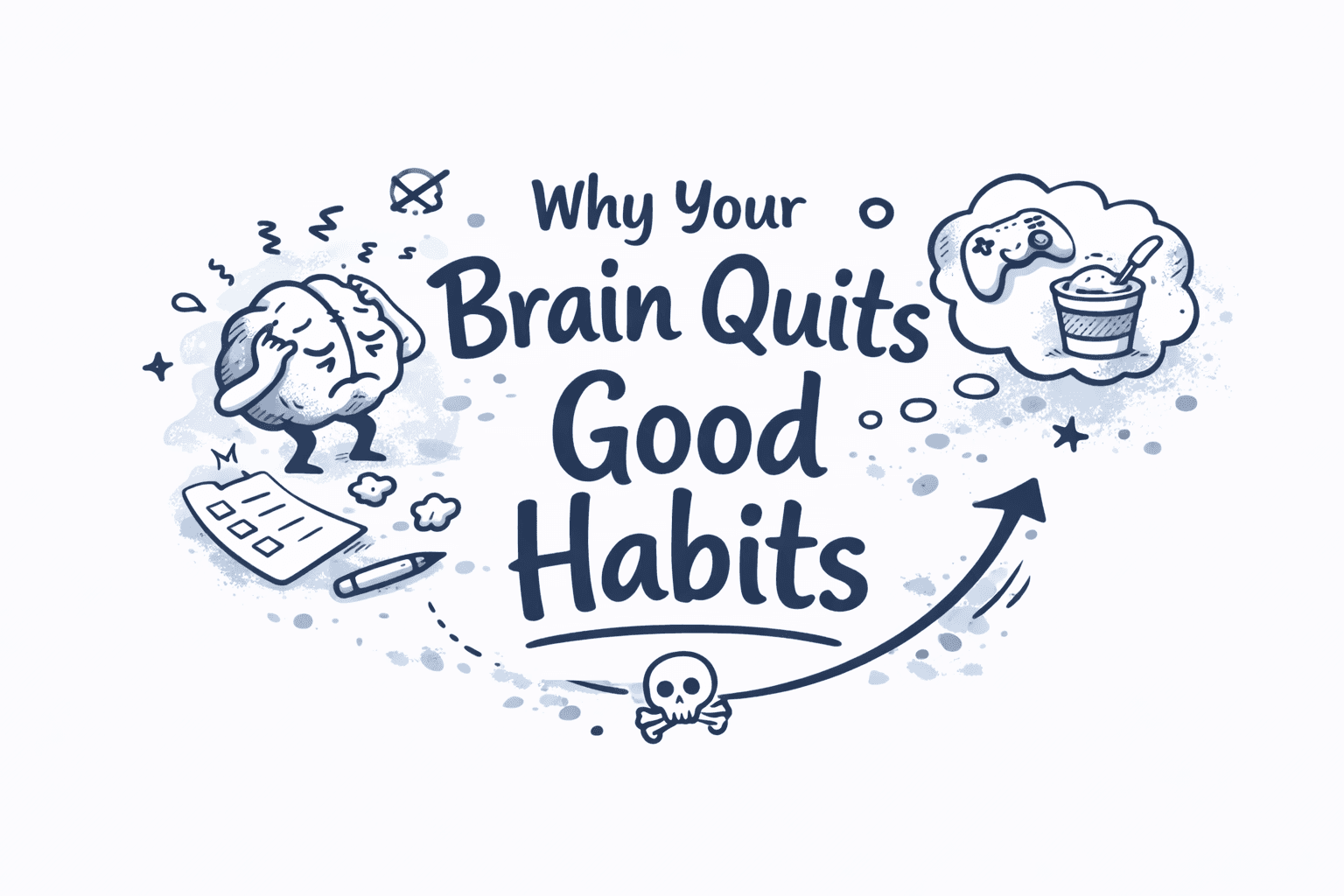
The Boredom Problem: Why Your Brain Quits Good Habits
Nobody talks about this one.
Every habit article covers motivation, willpower, streaks, and identity. But in my experience — and backed by research — the most common reason people quietly abandon a habit that's actually working isn't failure. It isn't a bad day or a broken streak.
It's boredom.
You started meditating and it felt transformative. Now it's week six and it just feels like sitting there. You started journaling and it felt cathartic. Now it feels like a chore. You started your morning run and it felt like a revelation. Now it's just another thing on your list.
Nothing went wrong. The habit is working exactly as it should. But your brain has moved on — and it's pulling you with it.
Why Your Brain Is Wired to Abandon What Works
The human brain has a built-in novelty bias. Research from University College London found that novel stimuli trigger dopamine release in a way that familiar stimuli simply don't. New experiences light up your brain's reward circuitry. Repeated experiences, by design, produce a weaker and weaker response over time.
This is called habituation — and it's completely normal. It's actually a sign that your brain is working efficiently. Once something is familiar, your brain stops spending energy on it. The problem is that this same mechanism that makes habits automatic also makes them feel dull.
When you first started your habit, every session produced a small dopamine hit. The novelty, the sense of progress, the feeling of doing something good — all of it was rewarding. Now that same habit feels flat. Not because it stopped working. Because your brain already knows what's coming.
This is one of the most important things to understand about long-term habit formation: the initial excitement was never meant to last. It was the spark, not the fuel.
The Goldilocks Zone of Habit Maintenance
Psychologist Mihaly Csikszentmihalyi's research on flow — the state of deep, effortless engagement — found that humans are most engaged when a task is slightly challenging but not overwhelming. Too easy, and we zone out. Too hard, and we give up. The sweet spot is just beyond our current comfort level.
His findings, widely cited in behavioral science, suggest that the key to sustained engagement isn't making things easier. It's keeping them just hard enough to stay interesting.
This is why the habit that felt exciting in week one can feel unbearable by week eight — not because anything changed externally, but because you've outgrown the version of it you started with. The 10-minute walk that once pushed your limits now requires zero effort. The meditation that once felt like a stretch now feels routine.
Your habit needs to grow with you, or it will bore you out of it entirely.
Boredom Masquerades as Other Problems
This is what makes boredom so dangerous: it rarely shows up as boredom. It disguises itself.
You tell yourself you're too busy. You decide the habit isn't actually that important. You convince yourself you need a new system, a better app, a different routine. You start researching alternatives instead of doing the thing. You feel vague resistance without being able to name it.
Underneath almost all of that, if you look closely enough, is just boredom.
Behavioral scientists at the University of Waterloo found that boredom is closely linked to a drop in sense of meaning — people who are bored don't just feel unstimulated, they start to question whether the activity matters at all. This is exactly how good habits die. Not with a dramatic decision to quit, but with a gradual erosion of perceived value.
The habit isn't the problem. The story your bored brain is telling you about the habit is.
The Progression Principle: Make It Slightly Harder
The most effective antidote to habit boredom isn't variety for its own sake. It's deliberate progression — consistently making the habit slightly more challenging in a way that keeps your brain just engaged enough.
Research on motor learning and skill development shows that incremental difficulty increases maintain motivation and engagement over time by keeping the challenge slightly ahead of current ability. This is the same principle elite athletes, musicians, and performers use to sustain decades of practice without burning out.
Applied to everyday habits, it looks like this: your 10-minute walk becomes a 12-minute walk, then a walk with intervals, then a walk while listening to something that requires active engagement. Your meditation goes from breath focus to body scan to open awareness. Your journaling moves from free writing to structured reflection to specific prompts that make you think harder.
None of these are dramatic changes. But each one gives your brain just enough novelty to stay interested — and that's all it needs.
This ties directly into the logic of keystone habits: once a foundational habit is automatic, it becomes the launchpad for a more challenging version of itself. The habit doesn't stay the same forever — it evolves while staying rooted in the same daily slot.
The "Same But Different" Strategy
Progression works for performance-based habits. But for habits that are more intrinsic — meditation, journaling, gratitude practice — the progression principle looks slightly different.
Here the strategy is what I call "same but different": keep the core behavior identical, but vary the context, format, or focus just enough to maintain freshness without disrupting the automaticity you've built.
Same meditation habit, different guided focus. Same journaling habit, different prompt. Same morning walk, different route. Same reading habit, different genre. The neural pathway stays intact. The behavior stays consistent. But your brain gets just enough novelty to avoid the flatness that leads to quitting.
This isn't about making your habits exciting. It's about making them interesting enough to keep doing. There's a meaningful difference.
Tracking Gives Boredom a Competitor
One practical tool that directly combats habit boredom: streak tracking. When you use a daily habit tracker app to log your habits every day, you create a secondary source of engagement that runs alongside the habit itself.
Even when the habit feels flat, the streak doesn't. Protecting a 40-day streak is inherently interesting to your brain in a way that "meditate again today" simply isn't. The number introduces a game element — a low-stakes challenge that your novelty-seeking brain can latch onto.
This is the deeper psychology behind why streaks motivate you more than you think: they're not just a measure of consistency. They're an ongoing source of engagement that gives your brain something to protect, which keeps you showing up long after the habit itself stopped feeling exciting.
The Reframe That Changes Everything
Here's the most important mindset shift when it comes to boredom and habits
Boredom is not a signal that your habit is wrong. It's a signal that your habit is working.
The flatness you feel at week six or week ten is your brain telling you: this is no longer a novelty. This is normal now. This is who you are. And that is exactly the point. The goal was never to keep the habit feeling exciting forever. The goal was to make it so ordinary, so embedded, so automatic that not doing it would feel strange.
Boredom is the sensation of a habit becoming part of you.
The people who build lifelong habits aren't the ones who found a way to make them endlessly exciting. They're the ones who learned to show up anyway — with a small progression, a subtle variation, or just the quiet discipline of protecting something they built — even when it stopped feeling like anything special.
That's the habit. That's the work. That's the win.
Start building habits that last at kabitapp.com — and track every day until boring becomes your biggest achievement.

Learn more
Discover more from the latest posts.